
Most of the floors that complain to Alex about pickup rates are, when he looks, calling once from a number the merchant has never seen. The merchant is in Texas and the screen says Philadelphia, and the call is declined before the second ring. The rep marks the lead as not answering, and the lead gets the blame.
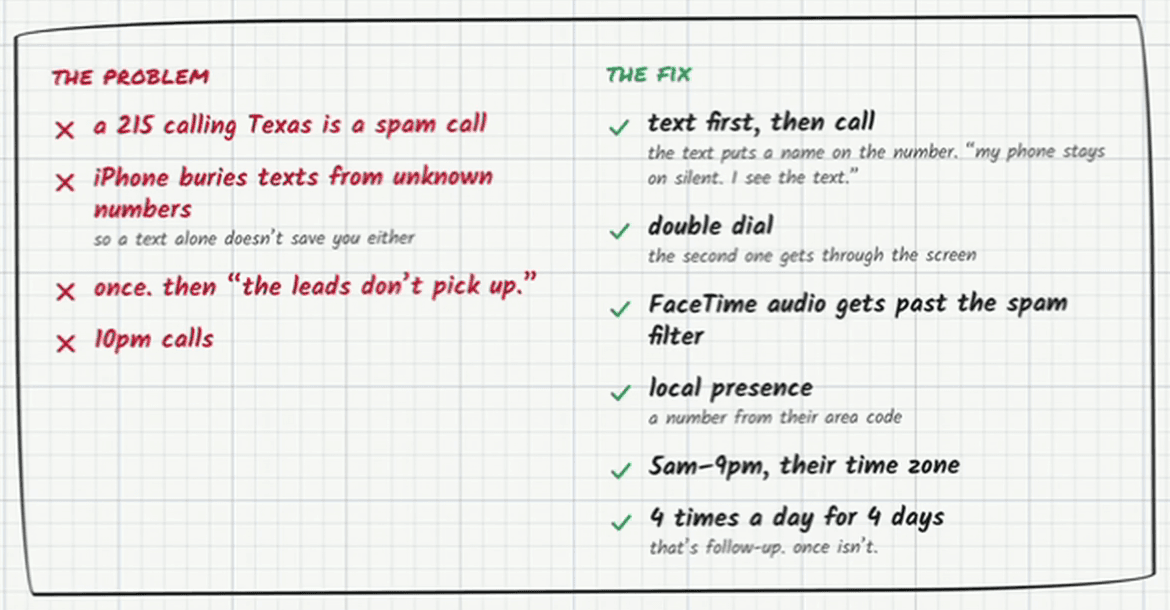
What gets through, and what to watch
| Tactic | What it does | Watch for |
|---|---|---|
| Text first | Puts a name on the number before it rings | Consent, and iPhones filing unknown senders |
| Double dial | The second call straight after the first gets through the screen | It counts as two calls where calls are capped |
| Local presence | A number from their area code is not an out-of-state stranger | Real numbers you own, kept clean |
| FaceTime audio | Arrives outside the carrier’s spam filter | iPhone to iPhone only |
| 8am to 9pm, their time zone | The call lands when they can take it | Tighter windows in some states |
| Four a day for four days | Enough swings for one to land | Three calls a day in Oklahoma and Maryland |
The double dial is the cheapest thing on the list. One missed call from an unknown number is ignored; a second straight after it reads as something real, and in Alex’s words it is the one that gets through the screen. It is the first attempt in the follow-up cadence for that reason.
Local presence means calling from numbers in the merchant’s own state or area code, and a floor calling nationally can hold several. Alex says it helps a lot. It is a dialler feature worth paying for, with that post’s caveat attached: numbers rotated carelessly get labelled as spam by the carriers, which puts you back where you started.
FaceTime audio is the one most floors have never tried. A FaceTime call comes through Apple rather than the phone carrier, so the carrier’s spam labelling does not touch it. It only works iPhone to iPhone, and Alex puts it after the double dial, not before — the same idea as his advice for a merchant buried in calls from other brokers: send a FaceTime, anything that breaks through the noise.
Why one call is never the test
Alex’s picture of a single call is trying to fell an oak with one swing of an axe. The merchant is running a business — payroll, employees, a fridge that broke, a tractor-trailer off the road — and the call that lands is the one that arrives when they can take it. You only find that moment by making several. His recommendation to clients is four times a day for four days across every channel — call, text, email — then once a day, and the later touches can be automated.
And inside their hours. A 10pm call is not persistence, it is a reason to block the number: calling windows run on the merchant’s clock, 8am to 9pm federally and tighter in some states.
Questions brokers ask
How do I get merchants to answer calls from an unknown number?
Text first so the call has a name on it, double dial when the first call is not answered, call from a number in their area code, and keep to 8am to 9pm in their time zone. Then make more than one attempt: four touches a day for four days is Alex’s rule.
Does local presence dialling work for MCA leads?
It helps a lot, in Alex’s experience: a number from the merchant’s own state does not read as an out-of-state stranger. Use real numbers you own and keep them clean, because carriers label numbers as spam by how they behave.
Why call a merchant on FaceTime audio?
Because it gets past the spam filter. A FaceTime call comes through Apple rather than the phone carrier, so the carrier’s spam labelling does not apply. It only works when both of you are on iPhones.
Is double dialling a lead worth it?
Yes. A second call straight after an unanswered first one gets through where the first did not, and it costs one extra dial. In Oklahoma and Maryland, where calls are capped at three in 24 hours, it uses two of the three.
How many times a day should I contact an MCA lead?
Alex recommends four touches a day for the first four days, across call, text and email, then once a day. Where state law caps calls at three in 24 hours, make the fourth an email.

Alex Makowski
Founder, Infinite Bookings
Runs the lead generation operation behind Infinite Bookings — paid traffic, the funding application, and the delivery pipeline that puts records into brokers’ CRMs.
Reachable directly at alex@infinitebookings.com or 732-609-7182.