The short answer
An MCA funnel has four links — the ad, the landing page, the conversion event and the sales process — and a merchant only gets across if all four make the same offer with the same numbers. A line of credit in the ad and an MCA on the page, or up to $20 million in the ad and $10K on the page, breaks the chain. Our example ads that each produced 250 qualified leads all say $500K because the page they send traffic to does.
Every broker agrees the ad and the page should match, and very few funnels actually do. The ad is written by whoever makes the creative, the page by whoever built the funnel and the script by the sales manager, and nobody reads all three in a row the way a merchant meets them. Our creative checklist puts the rule as plainly as it can: the same numbers as the landing page.

Four links in one chain
| Link | What it has to repeat |
|---|---|
| The ad | One product, one amount, one merchant |
| The landing page | The same product and the same amount, at the top of the page |
| The conversion event | An application for the thing the ad offered |
| The sales process | The offer the merchant clicked on, from the first line of the call |
We think of it as a bridge. The merchant has to get from seeing the ad to a funded file, and every link has to hold for them to get across. You cannot talk about lines of credit in the ad, advertise MCAs on the landing page and talk about something else again in the sales process. You cannot say up to $20 million in funding in the ad and then $10K on the page. Each mismatch is a point where the merchant who arrived for the first offer decides this is not it, and leaves.
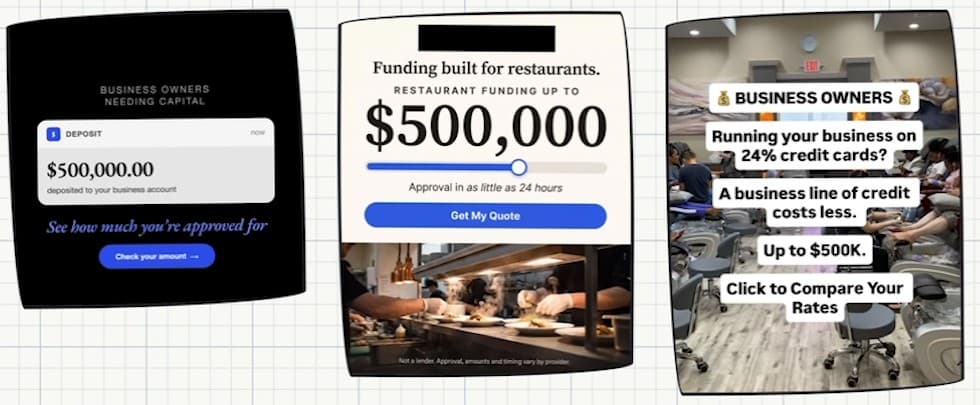
Those three each produced at least 250 qualified leads, and they have almost nothing in common except the number. One is a black card with a deposit notification, one is a restaurant ad over a kitchen, one is a situation laid over a nail salon. The angle changes from ad to ad; the offer the merchant lands on does not.
Where it usually breaks
- The amount. Creative that tests a bigger number than the page states. Change the page first, or do not run the ad.
- The product. An ad for a line of credit sending traffic to a page written for advances. The page has to offer what the ad offered, in the same words.
- The revenue figure. The ad names at least double the revenue you want, and the page should say the same figure. Only the form’s revenue band sits at the real floor: the ad and the page shape who arrives, and the form decides who counts.
- The call. A rep who opens with the product they would rather sell instead of the one the merchant asked about. The first thirty seconds should pick up the offer the merchant clicked on.
None of this needs a tool. Read the ad, the page and the first line of the script in a row, in the order a merchant meets them, and every link that says something different is a leak. The rest of what goes into the ad is on the creative checklist.