The short answer
A winning MCA creative carries as many as it can of five things — situation-based messaging, a revenue figure at least double the merchant you want, the same numbers as the landing page, one idea, and a relevant visual — and none of five others: guarantee language, numbers under your floor, rates or APR, rescue framing and “bad credit OK”. The creative is the targeting, so every cross that gets into an ad moves the merchants it brings further from fundable.
Most brokers picture Meta as a black box: a creative and a budget go in, and leads come out the other side. The part that gets missed is that the creative decides which leads. What the ad says is who fills in the form, which makes the creative the most important input a campaign has — more than the budget, and far more than the audience settings.
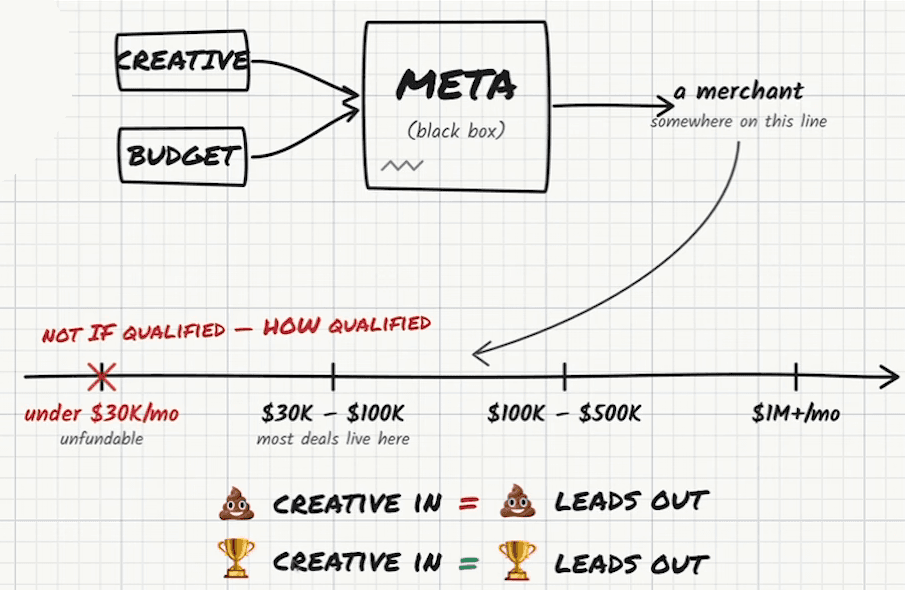
Not whether a lead is qualified, but how qualified
Qualification gets treated as a yes or a no, and it is a line. Below $25,000 to $30,000 a month a merchant is effectively unfundable, or fundable for so little that the call is not worth making, and most of the deals that do fund sit between $30,000 and $100,000. Above the floor, revenue is only one of the things that decide what a file is worth: how many positions are open, whether the merchant has defaulted before, the credit score. Together they make a cumulative lead score, and the creative is the input that moves the average merchant along it. Bad creative in, bad leads out.
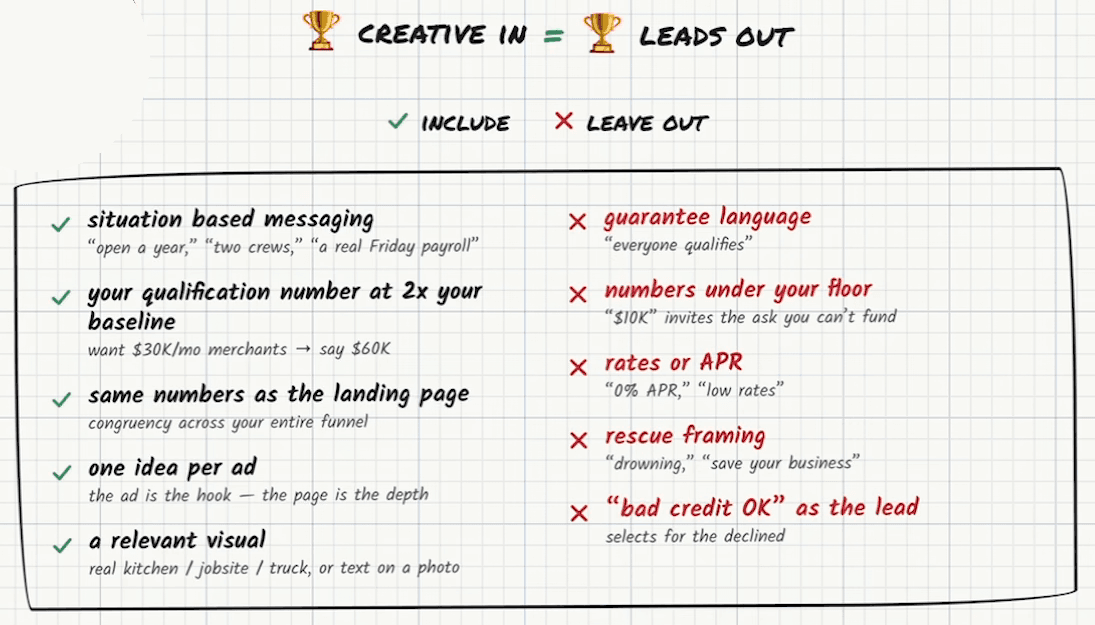
The five things to put in
| Include | What it looks like | Why it works |
|---|---|---|
| Situation-based messaging | The walk-in fridge that broke the Friday before Labor Day; “a real Friday payroll” | A merchant who recognises the problem trusts the ad and clicks sooner |
| A revenue figure at least 2x your baseline | Want $50K-a-month merchants? The ad says $100K | Submissions average about half the number in the ad |
| The same numbers as the landing page | Every one of our example ads says $500K, because the page does | The ad, the page and the call are links in one chain |
| One idea per ad | One product, one merchant, one number | The ad is the hook and the page is the depth. Simple scales |
| A relevant visual | A real kitchen, a job site, a broken-down truck | The picture picks the industry as much as the copy does |
Four of the five have their own write-up: situation-based messaging, the halving rule behind the 2x, offer congruency from the ad to the call, and why the picture picks the industry. The one that needs no post is one idea per ad. A creative offering an SBA loan, a term loan, equipment finance and an MCA, from $500K to $2 million, to landscapers and dental clinics, confuses everyone and stops nobody. The ad only has to earn the click from the right merchant; the page and the call can explain the rest.
The five things to leave out
- Guarantee language. “Everyone qualifies” is not true, it does not help the ad, and if it did help it would still be misleading.
- Numbers under your floor. If you do not fund under $10K, do not put $10K in the ad, because that is the merchant it will bring. Start at $15K or $25K, and higher if you want the larger file.
- Rates or APR. “0% APR” and “low rates” bring window shoppers who came for the rate and will not be sold on anything else, and there are better value propositions to lead with.
- Rescue framing. “Drowning” and “save your business” are situation-based messaging aimed at the wrong situation: the merchant you do not want to fund.
- “Bad credit OK” as the lead. It selects for the declined — distressed merchants, usually already stacked, who fund rarely and badly.
Why the checklist gets used every day
At close to 1,000 leads a week our account goes through 100 to 150 creatives a week, because at that spend even a winning ad is gone within a month or two. The checklist is what keeps that volume from drifting into the ads everyone else runs. It matters most at the start: until the pixel is seasoned on the merchants you want, the creative is doing most of the targeting by itself.