
On this page
Every lead vendor says the phones are verified. The word covers two different things, and only one of them does anything for your pickup rate. Alex’s board puts the difference in two lines: validated means a database said it is a cell; OTP means the merchant had the phone in their hand.
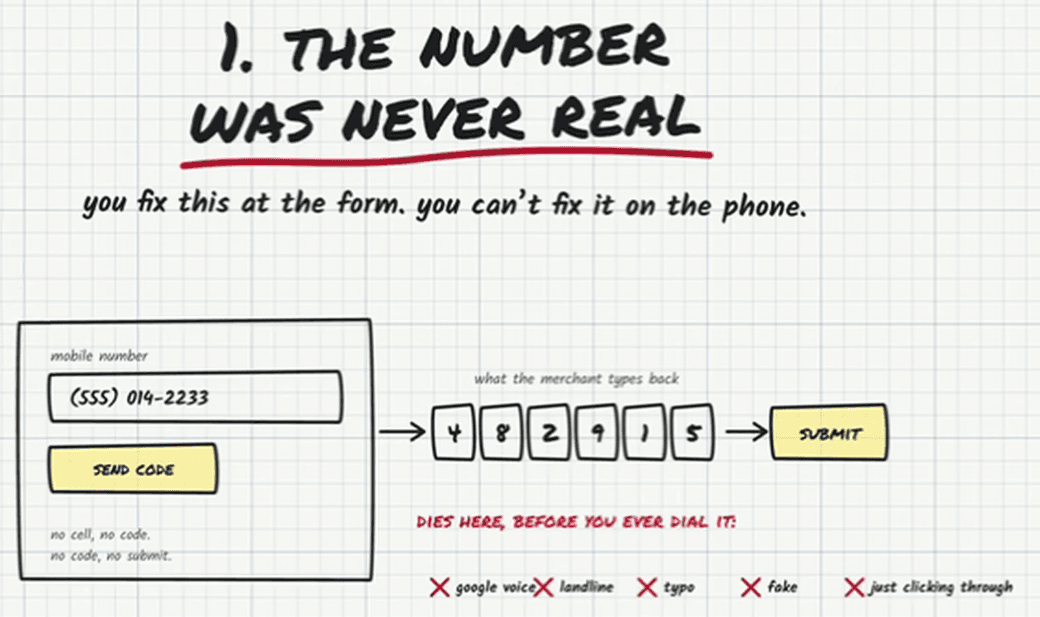
What each word actually tells you
| Question | “Validated” | OTP-verified |
|---|---|---|
| What happened | A database lookup said the number is a mobile line | A code went to the phone and the merchant typed it back |
| When | Whenever the vendor ran the lookup | Seconds before the application submitted |
| A mistyped digit that lands on a real phone | Passes — it is somebody’s cell | Fails — the merchant never sees the code |
| A number they never meant to answer | Passes | Fails unless it is a phone they are holding |
| What proof looks like | A lookup result | A code-sent and a code-entered time on every lead |
The third row is the one that costs brokers most without anyone noticing. A validated number can be real, mobile and the wrong one: one mistyped digit that happens to land on somebody else’s phone passes every database there is, and the lead is gone without anyone knowing it is gone. A code cannot be typed back from a phone the merchant does not have.
Ask for proof, because it is easy to spoof
Alex’s advice on vendors is not to take the word, his included: make sure they run a one-time passcode, and make sure they can send proof that every lead went through it, because it is very easy to spoof. The proof is ordinary data. An OTP-verified lead has a moment the code was sent and a moment it was entered, seconds apart, and a recording of the merchant completing the application shows them doing it. Our exclusive leads come with a TrustedForm certificate for that reason. A vendor who can produce the proof for one record can produce it for all of them.
What the code costs, and why it is still the cheap option
The passcode throws traffic away, so cost per lead goes up. Alex is explicit that you will pay more per lead and that it is much more worth it: the numbers that fail the code were never going to be answered, and on his funnel it holds spam to one to three percent without a captcha. Where it sits matters as well — as the last step of the application, which is what makes it the one piece of good friction on the form.
It is also the one pickup problem you cannot fix on the phone. A floor can dial faster and follow up harder; it cannot call a number that belongs to nobody. That makes it the first thing to rule out when leads do not pick up, and the only one of the four the vendor fully owns.
Questions brokers ask
What does OTP-verified mean on an MCA lead?
That a six-digit code was sent to the phone number on the application and the merchant typed it back before the application would submit. It proves they had that phone in their hand at that moment, which a database check cannot.
Is a validated phone number the same as a verified one?
No. Validated means a database said the number exists and is a mobile line. It cannot tell you whether the merchant typed it correctly or whether it is theirs; a one-time code can.
How do I know a lead vendor really uses a one-time passcode?
Ask for the code-sent and code-entered times on a sample of real leads. Every OTP-verified lead has both, seconds apart, and a vendor with the passcode on the form has them already. It is easy to claim and easy to spoof, so ask for the data rather than the assurance.
Does OTP verification make MCA leads more expensive?
Yes, because traffic that cannot receive and return a code is thrown away. It is worth it: those numbers were never going to be answered, and the passcode holds spam to one to three percent on Alex’s funnel.
Where should the one-time passcode go on a funding application?
As the last step. The merchant completes the application, the code goes to the mobile number they gave, and until it is typed back the application does not submit and no lead exists.
Reference
What comes with each exclusive leadThe six-digit code on every number, and a TrustedForm certificate that records the merchant completing the application.

Alex Makowski
Founder, Infinite Bookings
Runs the lead generation operation behind Infinite Bookings — paid traffic, the funding application, and the delivery pipeline that puts records into brokers’ CRMs.
Reachable directly at alex@infinitebookings.com or 732-609-7182.