
On this page
Every broker who buys leads has had the week where nobody picks up, and the instinct is to blame the batch. Sometimes that is right. But a low pickup rate has four separate causes, they sit in different places — two before the phone ever rings, two on your floor — and the fix for one does nothing for the others. Alex’s shop generates close to a thousand leads a week and sees the CRM data its clients report back, which is where this list comes from.
The four, and where each one gets fixed
| Reason | What the rep runs into | Where it is fixed | The fix |
|---|---|---|---|
| The number was never real | A Google Voice line, the front desk, a number that belongs to someone else | At the form, before the lead exists | A six-digit code typed back as the last step |
| Their phone is already ringing | A merchant who has had five calls in six minutes and wants to know who you are | Partly at the vendor, mostly nowhere | Be the first call, say which application, buy exclusive |
| You called hours later | A merchant who does not remember applying | On your floor | Webhook into a CRM, dial inside sixty seconds, export monthly |
| You called once, from a number they don’t know | Nothing. It rang, it was declined, nobody tried again | On your floor | Text first, double dial, local number, four a day for four days |
One: the number was never real
Aged lead sheets, UCC data, two-dollar leads from somebody on the internet: the common thread is a phone number nobody proved. Some are fake. Most are just unverified — a Google Voice line texts never reach, the landline at the front desk, one mistyped digit that turns a real merchant into a dead lead nobody knows is dead. The board puts the whole point in one line: you fix this at the form, and you cannot fix it on the phone.
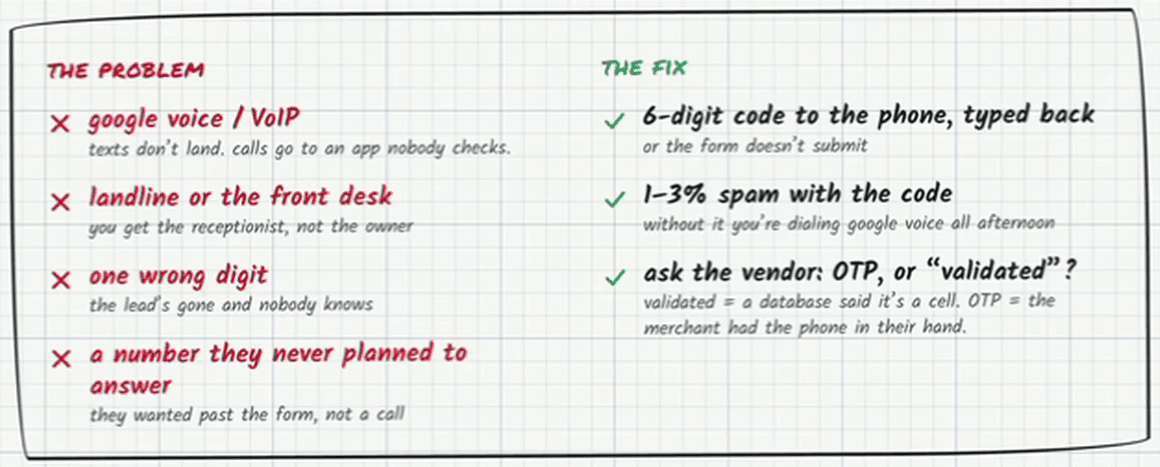
The fix is a six-digit code sent to the mobile number and typed back as the last step of the application: no code, no submission, no lead. It raises cost per lead and it is worth it. If you buy rather than build, the question for the vendor is whether their numbers are OTP-verified or just “validated”, and whether they can prove it on every lead.
Two: their phone is already ringing
A merchant who filled out four funding forms this morning is being called by every one of them, and if one of those vendors sold the lead to three buyers it is seven. By the time your call arrives they have stopped answering numbers they do not know, and nothing you or your vendor does stops the other forms. Exclusive leads narrow it rather than end it — Alex sees it on his own exclusive leads: merchants still fill out somebody else’s form the same morning.
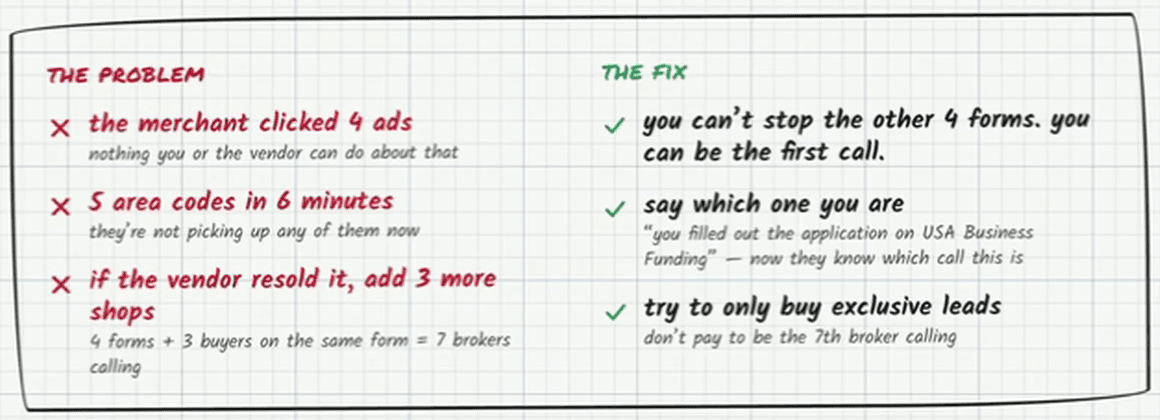
What is left is being the first call, saying which application you are calling about so the merchant knows which of the calls you are, and not paying to be the seventh. They filled out four forms goes through it.
Three: you called fourteen hours later
Ninety percent of the brokerages Alex talks to say they call right away. When he asks them to export the month, it is two hours, three hours, the next day. One client said their reps called right away, so he pulled the export: the median time to first dial was fourteen hours. Pickup falls by about sixty percent once thirty minutes have passed and keeps falling, so a fourteen-hour call reaches a merchant who does not remember applying.
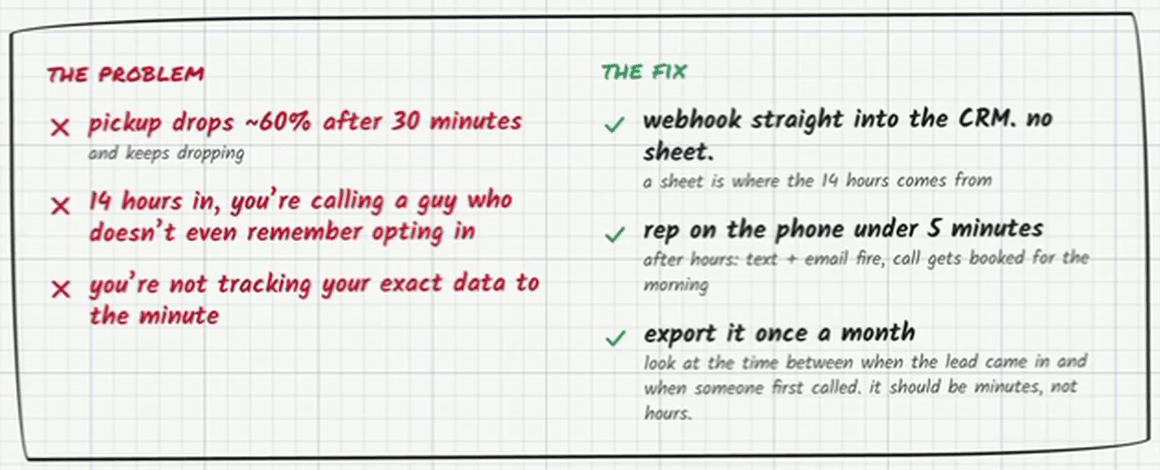
The fix is a webhook into a CRM rather than a Google Sheet, a rep on the phone inside sixty seconds — the essentials video treats five minutes as already burning the spend — and the export read once a month. Speed to lead has the fourteen-hour day on a timeline and the audit to run on your own data.
Four: you called once, from a number they have never seen
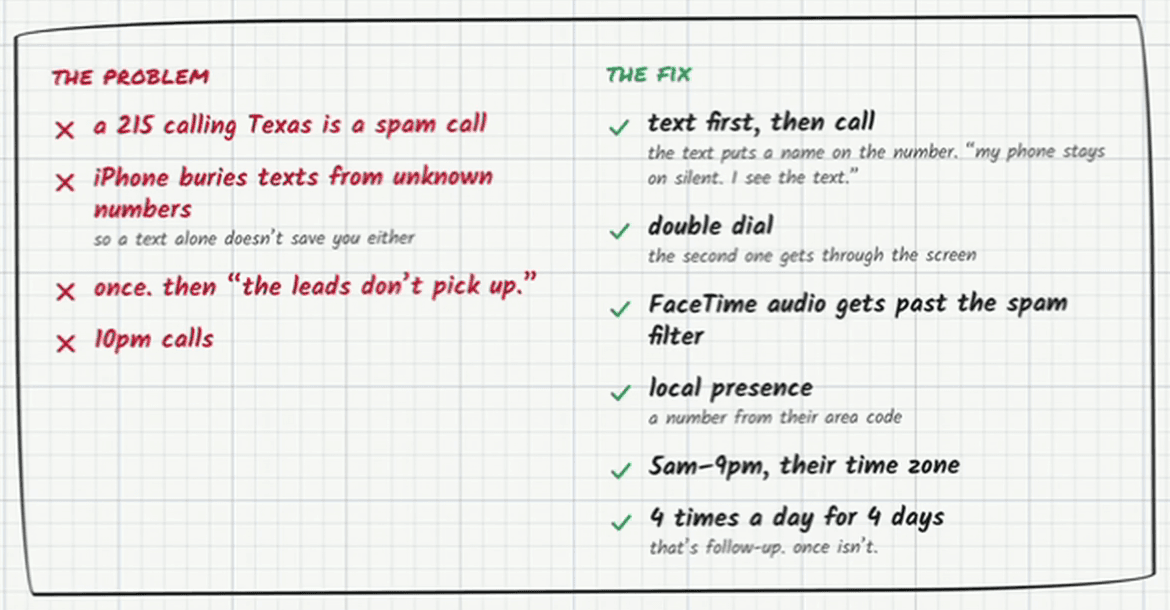
What the merchant sees is an unknown number, often from the wrong state — a 215 number calling a business in Texas reads as spam before it has rung twice. Text first, so the call arrives with a name on it: text first, then call has the message. Then double dial, use a local number, try FaceTime audio, and keep going; getting merchants to answer an unknown number covers each, and the follow-up cadence Alex recommends is four touches a day for four days, then once a day.
Alex’s summary of the list is that good leads do not rescue a slow floor. Even the best leads in the world need speed to lead, follow-up and a system, because the people on the other end are busy business owners with payroll, employees and a broken tractor-trailer to deal with. If you manage reps, his instruction is shorter still: export the data, look at it, and hold the floor to what it shows.
Questions brokers ask
Why is the pickup rate on my MCA leads so low?
One of four reasons: the number was never verified, the merchant has already had calls from other brokers, your first call came hours after they applied, or you called once from a number they did not recognise. Check your median time to first dial and your attempts per lead first — both are in your own CRM, and they are the most common cause.
Is a low pickup rate the lead vendor’s fault?
Sometimes. Numbers that were never verified, and leads sold to several brokers, are the vendor’s. Calling hours late and calling once are the floor’s, and they are the more common. Pull your time to first dial and attempts per lead before asking for replacements.
How fast should I call a new MCA lead?
Inside sixty seconds; five minutes is already late. On Alex’s board pickup drops by about sixty percent after thirty minutes and keeps dropping; fourteen hours in, the merchant does not remember applying.
Why won’t merchants answer calls from my reps?
Often because what they see is an unknown number from another state, which reads as spam. Text first so the call arrives with a name on it, double dial, call from a number in their area code, and make more than one attempt.
How many times should I call a lead before giving up?
More than once — Alex compares one call to felling an oak with one swing of an axe. He recommends four touches a day for four days across call, text and email, then once a day, automated where it can be.
Reference
The video this comes fromFourteen minutes on the four reasons, with chapters, the board and the full transcript.

Alex Makowski
Founder, Infinite Bookings
Runs the lead generation operation behind Infinite Bookings — paid traffic, the funding application, and the delivery pipeline that puts records into brokers’ CRMs.
Reachable directly at alex@infinitebookings.com or 732-609-7182.