
On this page
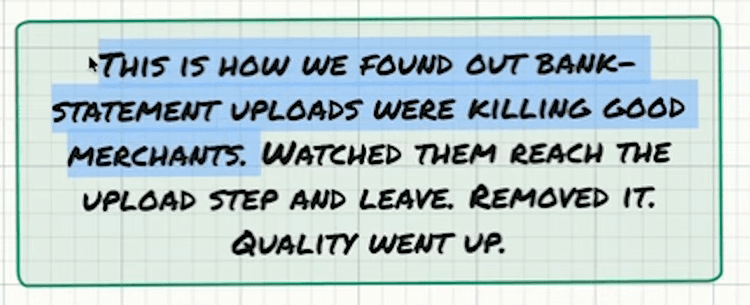
Asking for statements on the application is defensible on paper. A merchant who uploads four months of statements is obviously more serious than one who does not, the file arrives further along, and the reps stop chasing documents. We ran it, we watched what it did, and we took it off.
How it was found
Not from the conversion rate, which only says that fewer people finish than start. Microsoft Clarity records every session on the page, so the abandoned ones can be watched individually, and the pattern was unmistakable: merchants worked through the revenue question, the amount question and their contact details, arrived at the upload step, and left. Same step, over and over.
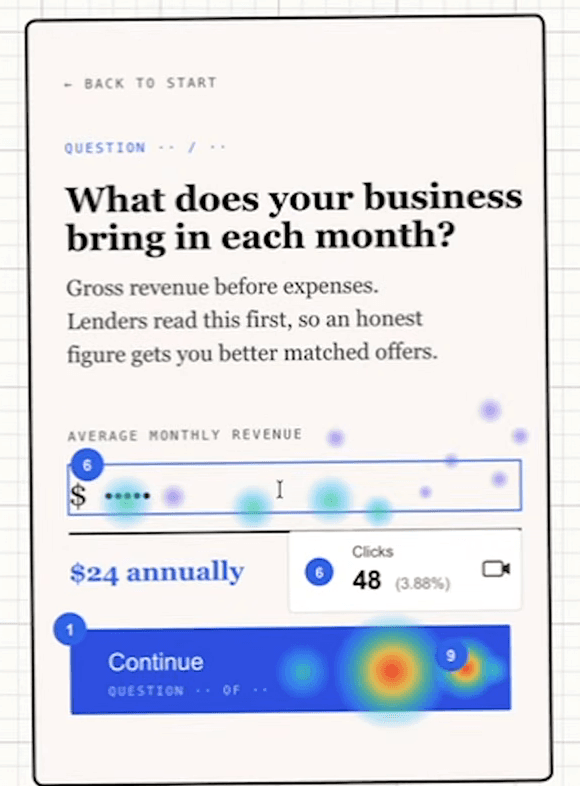
The important part of that pattern is who was leaving. A drop-off at the revenue question removes people below the floor, which is the form working. A drop-off at a document upload removes whoever cannot lay hands on four months of statements in the next few minutes, and that is a test of what a merchant is doing at that moment rather than of what their business looks like. The merchant with $90,000 a month going through the account, on a phone, in a van, is exactly who you want, and exactly who cannot do it.
What happened when it came off
- Cost per lead fell significantly. More of the merchants who reached the step completed, on the same spend and the same creatives.
- Quality went up rather than down, which was the opposite of the argument for keeping it. The gates that actually qualify — revenue, amount, time in business, state — were all in front of the upload, so nothing that was doing the qualifying was removed.
- The pixel got a bigger and cleaner sample. Every merchant who used to leave at the upload was a conversion event Meta never received, and they were disproportionately the busy ones.
- Statements still arrive. They arrive on the phone call, where a rep can explain why they are needed and walk the merchant through sending them, which is a conversation rather than a wall.
The general rule it points at
Friction on an application is only good when the people it removes are people you did not want. A one-time passcode qualifies because everyone it stops has an unreachable phone. A document upload does not, because it sorts merchants by whether they are at a desk. The test is not how much effort a step costs; it is whether the effort correlates with anything you are trying to find out.
It also points at the wider habit. There is a specific reason any funnel underperforms, and it is usually visible in the recordings within an afternoon. We would not have found this one from a conversion rate, a benchmark, or an argument in a meeting — only from watching about twenty people do the same thing and stop at the same place.
Questions brokers ask
Should an MCA application form ask for bank statements?
No. On our funnel the upload step lost merchants who had already cleared every qualifying question, and removing it lowered cost per lead while quality went up. Collect statements on the call instead.
How do you know the bank statement step was the problem?
Session recordings. Microsoft Clarity records every visit, including the abandoned ones, so merchants could be watched working through the form and leaving at the same step repeatedly.
Doesn’t asking for statements improve lead quality?
It filters for merchants who happen to be at a desk with their statements to hand, which is not the same as filtering for merchants who fund. The revenue, amount and time-in-business questions do the qualifying, and they sit in front of the upload anyway.
What about Plaid instead of a file upload?
It is the least bad version, because it is a login rather than a document hunt. It still raises cost per lead, and after what the recordings showed we would treat it as a narrow exception rather than a default.
When should a broker ask for bank statements?
On the phone, once a rep has established what the merchant needs and why the statements are required. That is a conversation the merchant can be walked through, and it converts far better than a silent upload box.

Alex Makowski
Founder, Infinite Bookings
Runs the lead generation operation behind Infinite Bookings — paid traffic, the funding application, and the delivery pipeline that puts records into brokers’ CRMs.
Reachable directly at alex@infinitebookings.com or 732-609-7182.