The short answer
Demographic messaging says who the merchant is: a New Jersey business owner, a landscaper, a business doing $30K a month. Situation-based messaging describes what is happening to them, such as the walk-in fridge that broke on the Friday night before Labor Day weekend. It is the first thing on our creative checklist, because a merchant who recognises their own problem in an ad trusts it, clicks sooner and trusts the broker further into the sale.
Most funding ads describe the merchant. “Are you a landscaping business owner?” “New Jersey business owners doing $30K a month.” Every one of those is a demographic, and most of the ads in the Meta ad library are built on the same few. The first thing on our creative checklist is to describe the merchant’s situation instead.

| Demographic | Situation |
|---|---|
| “Restaurant owners” | The walk-in fridge broke on the Friday night before Labor Day weekend |
| “Business owners doing $30K a month” | A real Friday payroll to make |
| “Landscaping business owners” | Two crews to keep working |
| “Six months or more in business” | Open a year |
| “Business owners” | Running the business on 24% credit cards |
Why a situation beats a demographic
A demographic tells the merchant the ad might be for them. A situation tells them the advertiser understands the problem they have this week, and that changes three things at once. The merchant stops scrolling, because the ad describes something that is actually happening. They trust the offer, because nobody describes a broken walk-in that precisely without knowing the business. And the trust carries into the sales process, because the rep is picking up a conversation the ad already started. The deeper the ad goes into the pain, the faster it sounds like it came from someone who knows the trade.
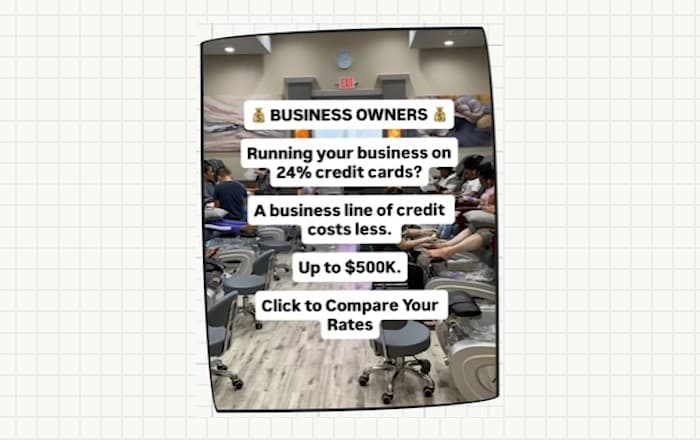
It combines well with the rest of the checklist. One of the ads that produced at least 250 qualified leads asks “Running your business on 24% credit cards?” over a photo of a nail salon, offers a business line of credit up to $500K, and never names an industry. One product, one merchant, one situation, and the picture picked the industry: the leads were nail salons.
Finding the situations
- Start from the reasons merchants give on the call: equipment that broke, payroll ahead of a slow week, stock before a busy season, a contract that needs financing to accept.
- Pin it to a moment. A fridge that broke is a situation; a fridge that broke on the Friday before a holiday weekend is an ad.
- Keep it to one. A second situation in the same creative is a second idea, and one idea per ad is on the checklist for a reason.
- Let the picture carry the industry, so the words can stay on the situation.
- Make several. Situation is the pain-point angle among the six angles, and like the other five it gets made in volume and judged by the data.
The call should pick up where the ad left off. A merchant who clicked on their own situation expects to talk about it, which is why the first thirty seconds open with one question about their situation rather than a pitch.