
On this page
Work out what a funded deal costs you in acquisition, then note that a renewal costs zero. That gap is the entire argument, and most shops still run renewals out of memory.
Why renewals underwrite better
- The funder has repayment history on this exact merchant, which is better information than any statement analysis.
- The merchant understands the product, so the conversation skips the education a first advance requires.
- Documentation is mostly on file, so the submission is faster to assemble.
- A merchant who repaid on schedule is a materially different risk from an unknown one at identical revenue.
Proportions are illustrative. The point is which bars exist at all — the two largest costs of a new deal simply do not appear on a renewal.
When a merchant becomes renewable
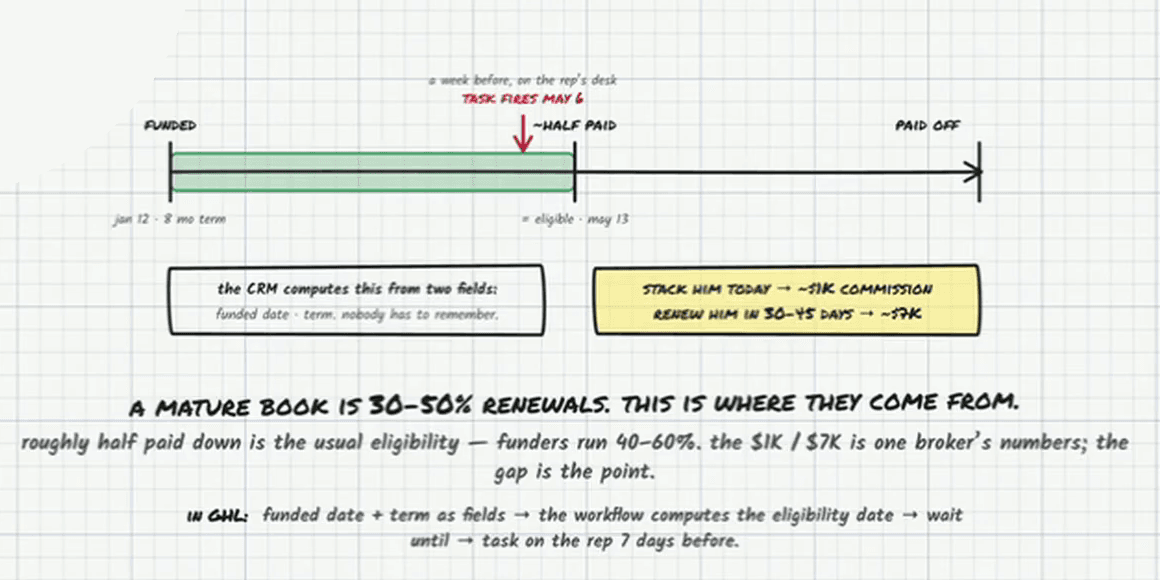
Roughly half paid down is the usual eligibility. Funders run anywhere from 40 to 60%, so check each one you place with, but half is the number to build around. The practical signal is timing rather than the exact percentage: the merchant starts thinking about the next one before the current one clears, not after.
Building a process rather than remembering
- Record the funded date and the term on every deal at the moment it funds. Not later.
- Let the CRM compute the eligibility date from those two fields — roughly the point where half is paid down. Nobody should be working it out by hand.
- Fire a task on the rep’s desk seven days before that date, so the conversation starts while the advance is still running.
- Track which merchants renewed and which did not, and ask the ones who did not why. That answer usually names something fixable.
- Keep a diary of declines that failed on time in business or a single bad month. Those are renewals that have not happened yet.
In GoHighLevel it is one automation: funded date and term as fields, a workflow that computes the eligibility date, waits until seven days before it, and puts a task on the rep. It is the sixth of the six automations the top brokerages run, and the reason is the size of the prize: a mature book is 30–50% renewals, and this is where they come from. The board puts one broker’s numbers on it — stack the merchant today for roughly $1K of commission, or renew him in 30–45 days for roughly $7K. The figures are one shop’s; the gap is the point.
What to say
Not "are you ready for more money." A merchant halfway through an advance has a live view of whether the remittance is working, and the useful conversation is about that. Whether the payment is sitting comfortably, what changed since they took it, what is coming up that needs capital. The renewal is the outcome of that conversation rather than its opening line.
Questions brokers ask
When can an MCA be renewed?
Roughly when half the existing advance is paid down, which is the usual eligibility; funders run from about 40 to 60%. The conversation belongs while the advance is still running, not after it clears.
Why are renewals more profitable for brokers?
They cost nothing to acquire, close faster because the merchant already understands the product, and underwrite better because the funder has repayment history on that exact merchant. The two largest costs of a new deal — lead spend and rep time to make contact — do not exist on a renewal.
When should you start the renewal conversation?
About a week before the merchant reaches eligibility, which is usually around half paid down. A merchant who clears an advance and hears nothing from you has clean receipts and a phone full of brokers working UCC lists.
How do you build a renewal process?
Record the funded date and term on every deal at the moment it funds, let the CRM compute the eligibility date at roughly half paid down, and fire a task on the rep seven days before it. Track who renewed and who did not, and ask the ones who did not why.
Do renewals underwrite differently?
Yes, and usually more favourably. The funder is looking at actual repayment behaviour on this merchant rather than inferring capacity from statements, and a merchant who has repaid on schedule is a materially different risk from an unknown one at the same revenue.

Alex Makowski
Founder, Infinite Bookings
Runs the lead generation operation behind Infinite Bookings — paid traffic, the funding application, and the delivery pipeline that puts records into brokers’ CRMs.
Reachable directly at alex@infinitebookings.com or 732-609-7182.