
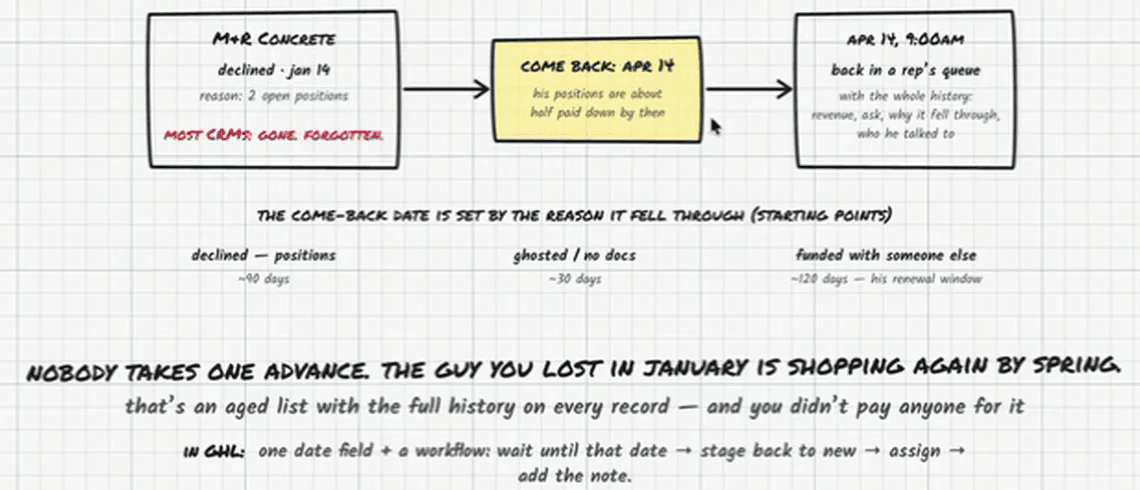
Every floor has a pile of records marked dead, and most of the reasons they died had a shelf life. Time in business increases. Positions get paid off. A competitor’s advance matures. Nobody takes just one advance, and the merchant you lost in January is shopping again by spring.
| Why it died | Return when | What changed |
|---|---|---|
| Under time in business | At the milestone | They now clear the floor |
| Too many positions | About 90 days | Their positions are about half paid down |
| Funded by someone else | About 120 days | Their renewal window |
| Negative days | 60–90 days | A clean quarter changes the file |
| Ghosted, or never sent documents | About 30 days | Circumstances, and their mood |
| Said no to funding | 90 days | Businesses need money later |
The renewal window is the valuable one
A merchant who funded with a competitor about four months ago is approaching the point where their advance is roughly half paid down — the usual renewal eligibility — and they are receptive to a renewal, usually from whoever calls. This is the single highest-value entry in the dead pile and it needs a calendar date rather than a hope.
In GoHighLevel it is one date field and a workflow: wait until that date, move the stage back to new, assign it, and add the note. The rep does not have to think or remember — and if a rep has to remember a lot of things, Alex’s point is that he will forget all of them. It is the fifth of the six automations the top brokerages run. The result is an aged list with the full history on every record, and you did not pay anyone for it.
What to say
- Reference the original conversation specifically. It proves this is not a fresh cold call.
- Name the thing that was in the way, and ask whether it still is.
- Do not re-pitch. Ask one question and let them tell you what changed.
- Re-check consent and suppression before dialling. A record cold for six months needs re-scrubbing.
The compliance step is not optional. Numbers get reassigned, people become plaintiffs, and consent gets revoked in the months while a record sits — a scrub from six months ago is evidence about a list that no longer exists.
Questions brokers ask
Are dead MCA leads worth calling again?
Often, yes — the reasons they died mostly expire. Time in business increases, positions get paid off, competitors’ advances mature. It costs only rep time on records you already bought.
When should you call back a merchant who funded elsewhere?
About 120 days later, as their advance approaches half paid down and they become eligible for, and receptive to, a renewal. It is the highest-value entry in a dead pile and it needs a diary date rather than good intentions.
How long should you wait before re-engaging a cold lead?
It depends on why it went cold: about 30 days for a merchant who ghosted or never sent documents, about 90 for a decline on positions, 60 to 90 for negative days, and at the milestone for time in business.
What should you say on a revival call?
Reference the original conversation specifically, name the obstacle that was in the way, and ask whether it still is. One question, then listen — re-pitching signals you did not remember them.
Do you need to re-scrub old leads before calling?
Yes. Numbers get reassigned, consent gets revoked and people become plaintiffs in the months a record sits idle. A six-month-old scrub is evidence about a list that no longer exists.

Alex Makowski
Founder, Infinite Bookings
Runs the lead generation operation behind Infinite Bookings — paid traffic, the funding application, and the delivery pipeline that puts records into brokers’ CRMs.
Reachable directly at alex@infinitebookings.com or 732-609-7182.