The short answer
A winning ad is gone within a month or two, so replace it while it is still winning. Make ten to fifteen variants with the same message — static, video, UGC, carousel and reel versions, a new photo, a new headline, an industry cut, a state cut, text on a photo — and let Meta find the next winner among them. You do not need to know what made the original work. More of what already works is the most risk-averse spend there is.
When an ad wins, the instinct is to leave it alone and go looking for the next idea. The better move is the opposite. The winner has already proved that something in it works on your merchants, and the cheapest next winner is a version of it Meta has not shown to anyone yet.
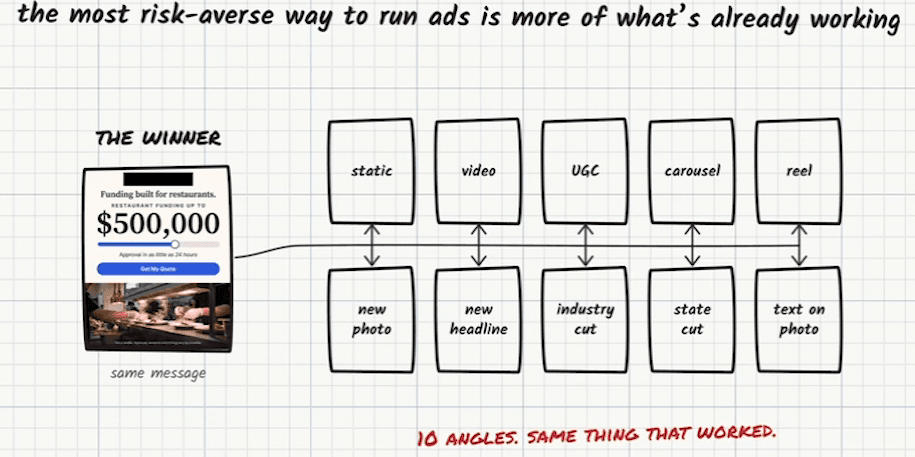
The ten
| Variant | What it is |
|---|---|
| Static | A new still layout of the same offer |
| Video | The offer as a short video |
| UGC | A person talking it through, shot on a phone |
| Carousel | The offer across several swipeable cards |
| Reel | A vertical, short-form cut |
| New photo | A different picture of the same industry |
| New headline | Different words at the top, the same offer underneath |
| Industry cut | The same ad aimed at another industry |
| State cut | The same ad with a state named in it |
| Text on photo | The copy laid over a real photo of the business |
The first five are formats, the next two are fresh executions, and the last three aim the ad at a new pocket of merchants; in the terms of the creative pipeline, all ten are new executions of a proven angle, which is the cheap kind of creative work. For the true winner on that board we went well past ten and made fifty: static images, video, UGC and carousels, in different colours, with different images and different numbers, looking for the common denominator of what worked and recreating it in other variables. That produced more winners.
Why it is the lowest-risk spend there is
Every other creative in the account is a guess. The winner is not: you know it works, and you know it has made you money. Running more variations of it is the most risk-averse way to spend on ads, and anything else is risking money for no reason. You do not need to know what it is about the winner that works, either. Something in that ad works; the variants keep the message and change what is around it, and Meta sorts out which of them carries it best. Variants also extend the winner’s life, so that when the original dies another winner is already running.
And keep making wildcards
Variants of winners are the safe half of the pipeline. The other half is new ideas, because every winner started as something untested. Alex makes five new creatives for MCA brokerages every day — weekends, sick days and travel days included — and deliberately makes them as different from each other as he can. His reasoning is that most brokerages are copying LendingTree, businessloans.com and the rest of the ad library, which is a reliable way to end up with nobody’s winners. Both halves are sized to the budget: roughly 20 to 30 new creatives a month at $100 a day, and ten to twenty times that at $1,000 a day.