The short answer
The generic ads the big lenders run in the Meta ad library work at $2,000 to $5,000 a day because of the pixel behind them, not the creative: a seasoned pixel already knows which leads were good and goes and finds more. A new account has none of that data, so a copied generic ad has nothing doing the targeting. Until the pixel is seasoned, the creative has to do the targeting and train the pixel, and the pixel is the most valuable asset the account will ever own.
The most common creative strategy in this market is to open the Meta ad library, look at what businessloans.com, LendingTree and BlueVine are running, and put your own logo on something similar. It feels like the safe option, since those companies spend more than anyone and presumably know what works. It leaves a broker permanently following someone else’s lead, and it rarely produces the best cost per lead or the best merchants.
What actually makes their ads work
At a certain spend — somewhere around $2,000 to $5,000 a day — the creative can be as plain as theirs. It can be the most generic ad there is and it will still convert, because the account has pixel data behind it. The pixel is not there to track your numbers. It is there to tell Meta which leads were actually good, so Meta knows who to find next, and an account that has told it that thousands of times gets even a generic ad in front of the right merchant.
| A new broker account | A lender spending $2,000 to $5,000 a day | |
|---|---|---|
| Pixel data | None yet | Plenty, on the merchants it wants |
| Who does the targeting | The creative | Mostly the pixel |
| Generic creative | Brings whoever will fill in a form | Still converts |
| What the creative has to do | Pick the merchant, and train the pixel | Much less |
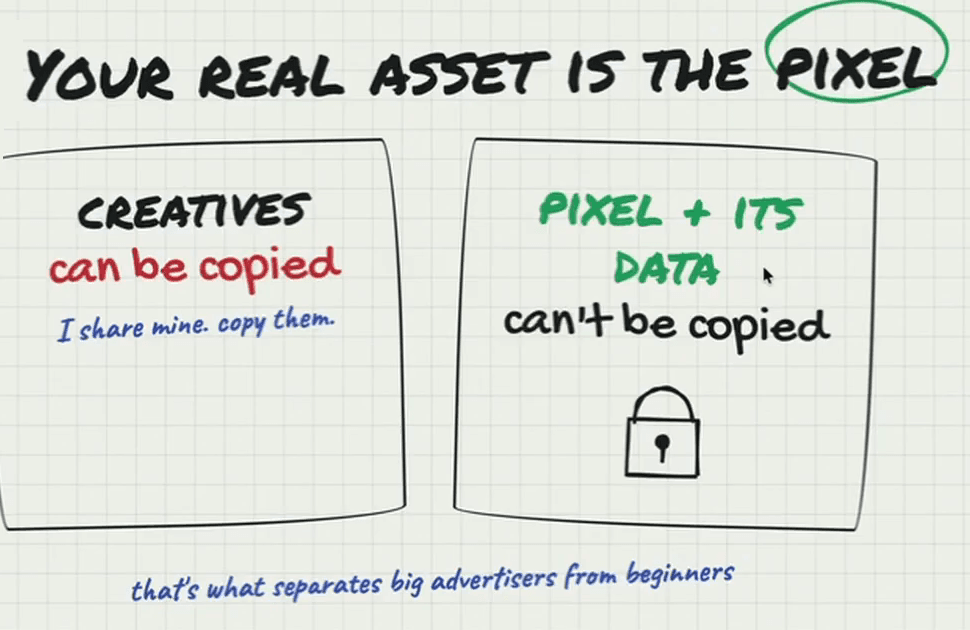
It is also why Alex posts the creatives that work for him on Instagram and YouTube without worrying about it. Anyone can copy them, the same way anyone can copy businessloans.com or NerdWallet out of the ad library, and nobody gets the same results by doing it: the account behind his ads gets thousands of conversion events a week, and that history is what cannot be copied. It is what separates an advertiser spending millions a month from one spending $100 a day.
Why a new account cannot copy that
A new account does not have the data, and nothing copied from the ad library brings it along. Run a big lender’s kind of creative on an empty pixel and nothing is selecting the merchant: the ad says nothing specific, so the ad is not doing the targeting, and the pixel has never been told what a good lead is, so it is not doing it either. That is why good creative matters most at the beginning. Every dollar spent early is also spent conditioning the pixel, and what the pixel learns is whoever the creative brought.
Do it right and the creative matters less, not nothing
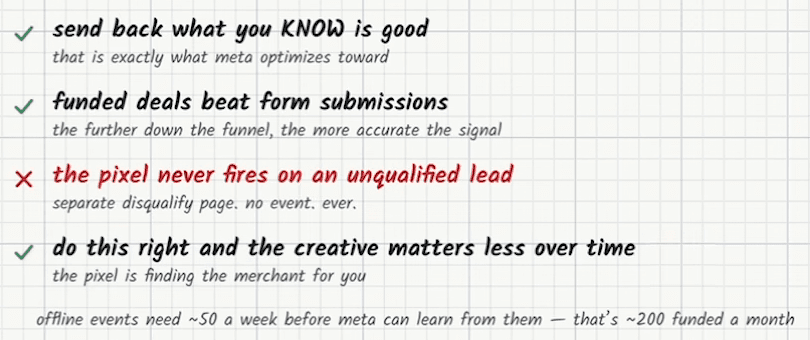
Send the pixel the right data for long enough, at about fifty conversion events a week, and it takes over most of the responsibility for putting the ad in front of the right merchant. The creative matters less over time. That is not permission to get lazy, and even a seasoned account keeps burning through creative at a rate set by its budget. What changes is how much the creative has to carry. Early on it is the whole creative checklist; later the pixel shares the load. Copying the big lenders skips to the later stage without the part that makes it work.
The alternative to copying is volume and difference. Alex makes five new creatives a day, as unlike each other as he can make them, precisely because everyone else is copying the same few companies, and the ones that win get ten variants each.