
On this page
The most common way a self-run lead channel dies is not a policy strike or a bad month. It is that the person who made the ads got busy, performance decayed quietly over six weeks, and by the time anybody looked the cost per lead had doubled.
The next winner is already running
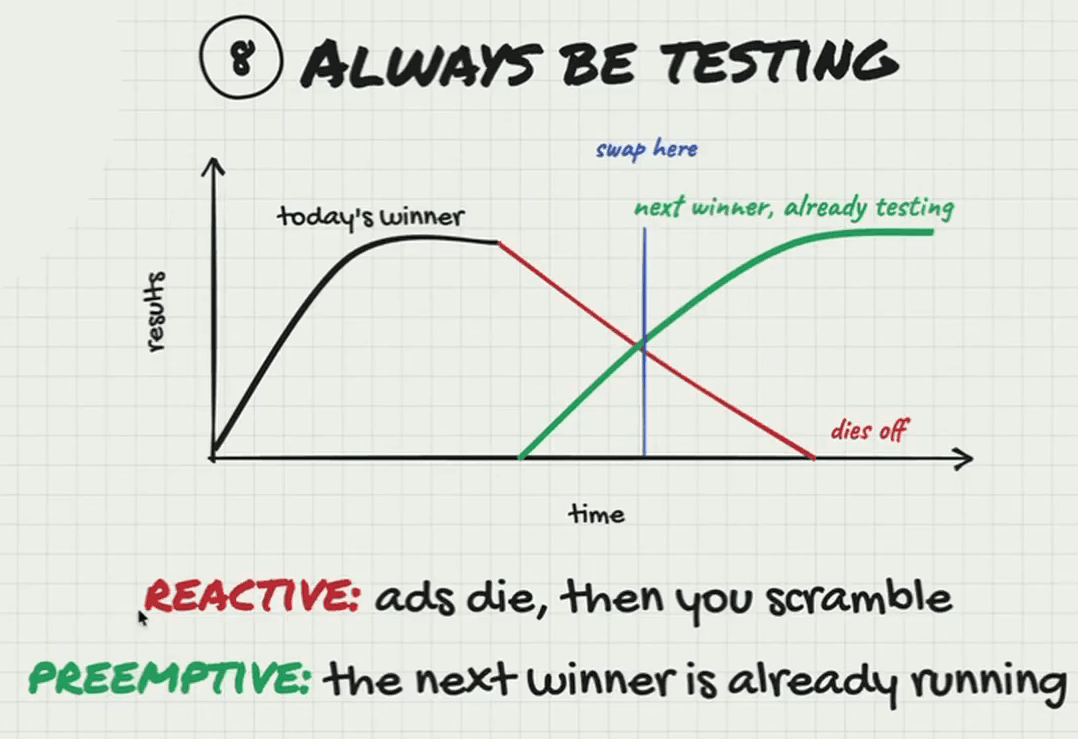
Whatever campaign is working right now will die eventually; Alex will guarantee it. The reactive version is to notice the cost per lead rising, then scramble for new creatives and new campaigns, which is when shortcuts get taken. The preemptive version is to test while things are going well, so the next winner is already running when today’s one fades. It is how our own clients get leads at a steady rate: when one of our main campaigns stops working, the next one is already sending leads. Testing costs money, and it is not optional; being frugal with it is how an account ends up diagnosing a dead campaign with nothing to replace it.
Angles and executions are different things
| Angle | Execution | |
|---|---|---|
| What it is | The argument the ad makes | How that argument is shown |
| Example | Speed of funding | A founder talking, versus text on screen |
| How many you need | Two or three that work | Many, continuously |
| Fatigues in | Months | Weeks |
| Replaced by | Testing new arguments | Re-shooting the same one |
Most brokers conclude an angle has stopped working when in fact an execution has worn out. Re-cutting a proven argument is cheap; abandoning it and starting the search again is not.
A workable cadence
- New executions of proven angles on a fixed schedule, whether or not performance has dropped.
- Ten variants of every winner, started while it is still winning: new formats, a new photo, a new headline, an industry cut, a state cut. Found a winner? Make ten of it.
- One genuinely new angle tested per cycle, with a small budget and a decision rule.
- Do not switch executions off because they feel stale, or because Meta has stopped spending on them. Meta puts about 90% of the spend on one or two ads and moves it as they fade; the only creative to switch off is one still taking the budget while its leads do not fund. At $100 a day there is one more: when new creatives go in, retire the ones Meta has stopped spending on, so the live set stays at ten to fifteen.
- Keep fatigued creative on file. It often works again months later against a partly refreshed audience.
How many creatives the budget needs
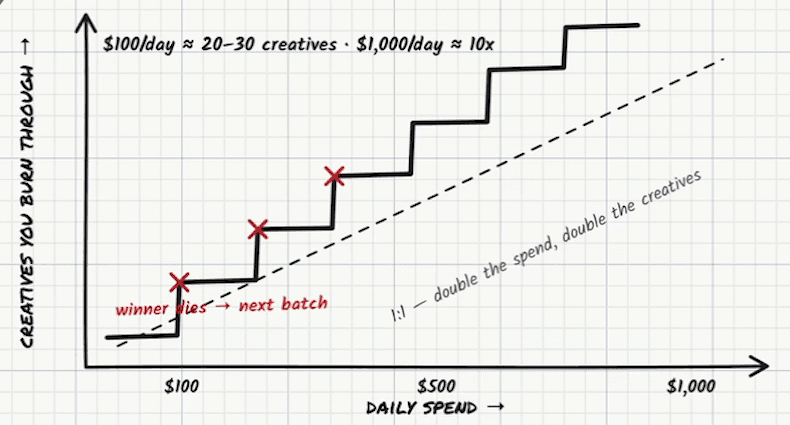
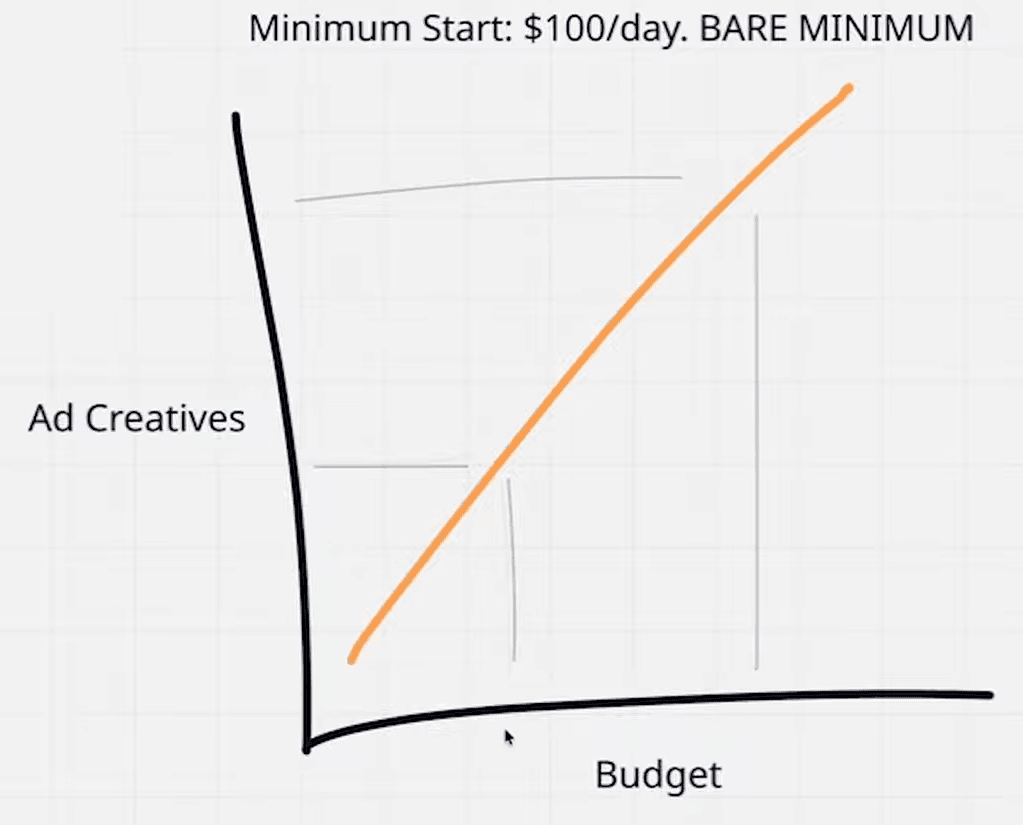
The number of creatives you need scales with spend, and faster than most brokers plan for. More budget means more traffic, which means each ad is shown to more people and reaches a high frequency sooner. At $100 a day — the floor below which a campaign should not run — 20 to 30 new creatives a month is enough. At $1,000 a day it is ten to twenty times that, not the same 30 running harder. The rule of thumb is one to one, double the spend and double the creatives, and past about $1,000 a day the burn runs ahead of it, at two to three times what the straight line would suggest. At close to 1,000 leads a week our own account goes through 100 to 150 creatives a week, across six angles, and almost none are switched off by hand: Meta concentrates the spend on one or two ads at a time, and that concentration is the system working.
Those are creatives made, not creatives live. At $100 a day the live set stays at ten to fifteen and never more than fifteen, because too many creatives on too little budget means nothing learns; the 20 to 30 a month go in as replacements for ads Meta has stopped spending on.
What to shoot
Plain, specific and unglossy tends to outperform produced work in this category, because the audience is business owners who distrust anything that looks like a finance advert. That is convenient — it means the pipeline is sustainable on a phone camera rather than dependent on a production budget.
Questions brokers ask
How fast do funding ads fatigue?
Even a winning ad is usually gone within a month or two, and sooner the more you spend. The underlying angle lasts much longer, which is why re-cutting a proven argument is far cheaper than searching for a new one.
What is the difference between an angle and an execution?
The angle is the argument the ad makes — speed, or no credit check. The execution is how it is shown. You need two or three working angles and a continuous supply of executions.
When should you turn an ad off?
Rarely. Meta moves spend away from fading creative by itself, so leave ads running. The exception is an ad still taking most of the budget while its leads do not fund; switch that one off. At $100 a day, also retire the ads Meta has stopped spending on when new ones go in, so no more than fifteen run at once.
Is a cheaper cost per lead always good?
No. A creative that halves cost per lead has usually found a cheaper audience, and cheaper audiences in this category fund at lower rates. Investigate a sudden drop rather than celebrating it.
How many ad creatives does a funding campaign need?
About 20 to 30 new ones a month at $100 a day, with no more than fifteen live at once, and ten to twenty times that at $1,000 a day, because each is shown to far more people and fatigues sooner. At close to 1,000 leads a week our own account goes through 100 to 150 a week.
Do funding ads need high production values?
Generally not. Plain and specific outperforms produced work, because business owners distrust anything that looks like a finance advert — which makes the pipeline sustainable on a phone camera.

Alex Makowski
Founder, Infinite Bookings
Runs the lead generation operation behind Infinite Bookings — paid traffic, the funding application, and the delivery pipeline that puts records into brokers’ CRMs.
Reachable directly at alex@infinitebookings.com or 732-609-7182.