The short answer
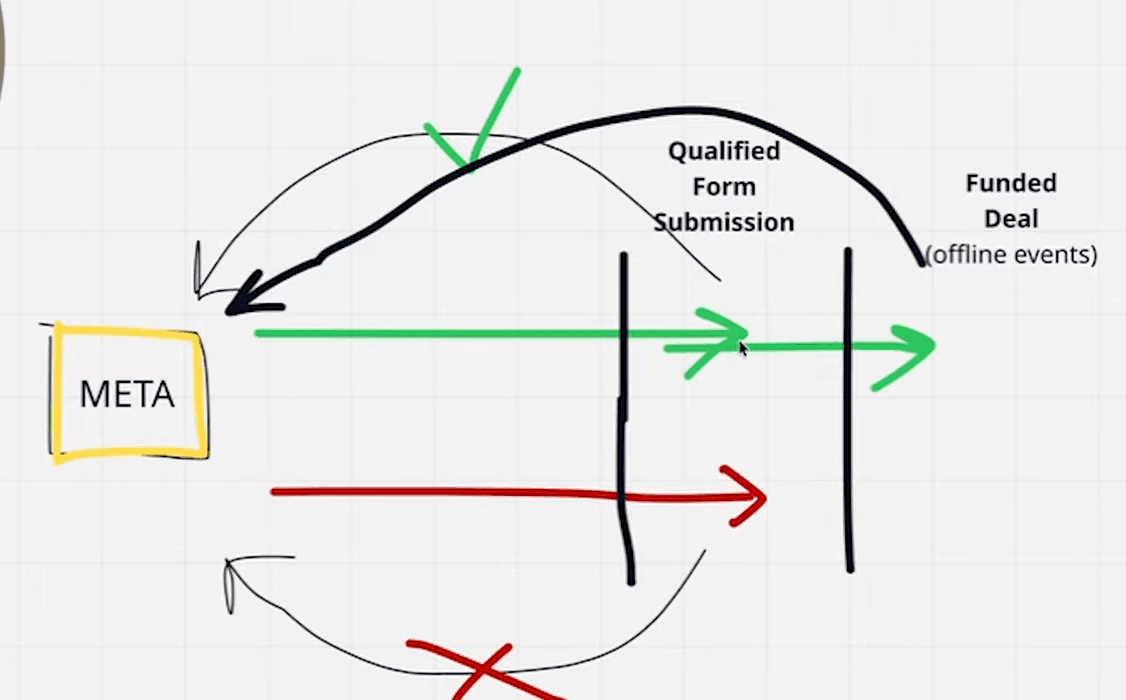
A funded deal is the highest-quality event a funding campaign can send back to Meta, and the algorithm needs about fifty of them a week to optimise on it — roughly two hundred funded deals a month from Facebook alone. Below that, feed it qualified submissions and nothing else. The offline-events step is for shops spending one to three thousand dollars a day, not a setting to switch on early.
Meta will optimise towards any event you send it, and the further down the funnel the event sits, the better the merchants it finds. Funded deals are the bottom of the funnel. The catch is arithmetic.
The threshold
| Weekly events sent | What Meta can do with them |
|---|---|
| Under 10 | Nothing useful; delivery stays in learning |
| 10 to 50 | Noisy; optimisation swings on single deals |
| 50 or more | Enough to optimise on — the point of the exercise |
At a five to fifteen percent funded rate on qualified leads, fifty funded deals a week means several hundred qualified submissions a week, which is a $1,000-to-$3,000-a-day account. That is who this is for. A shop at $100 to $500 a day sending back five funded deals a week is giving the algorithm a signal it cannot read, and taking it off the qualified-submission event that it could.
There is a middle step that needs no CRM integration at all. Once an account produces more than double the fifty — about 100 qualified leads a week, 400 a month — raise the bar on the qualified event itself: the form keeps its floor, and the pixel fires only for merchants above a higher one, raised a step at a time, as long as fifty a week still clear it. The third video calls it step 1.5.
Send them before you optimise on them
The fourth video adds a distinction this post was missing. The fifty-a-week rule governs when to point the campaign at funded deals, not when to start sending them. Below the threshold, send the events anyway so the pixel accumulates the history, and leave the campaign optimising on the qualified submission until the count is there. Expect weeks of funded events before the lead mix visibly moves — the lag is real and it is not a sign the setup is wrong.
It also settles the event type. A funded deal goes back as a standard Purchase with the deal amount as its value, not as a custom event: Purchase is what unlocks value-based bidding, so Meta chases deal size rather than deal count, and a $100,000 funding outweighs a $20,000 one. Send it the day it funds, because the older the event, the worse the match, and send it with hashed email and phone — a funded event Meta cannot match back to a click teaches it nothing.
If you are at the volume
- Keep the qualified-submission event running. Offline events are added on top, not swapped in.
- Send the funded deal from the CRM when it funds, as a Purchase with the deal amount as the value, matched on the hashed contact details the submission produced.
- Lender submissions logged in the CRM can be the offline event too. They sit between the qualified form and the funded deal, and a submission count reaches fifty a week well before a funded count does.
- Watch cost per funded deal rather than cost per lead once it is live — the whole point is that the two can move in opposite directions.
- Keep the disqualified path exactly as it was. A funded-deal event does not make it safe to send junk back.
For everyone else, and for any account under $1,000 a day, qualified submissions sent cleanly are good enough, and they are the only event to run. That is the event our own campaign optimises on at roughly $2,600 a day, and it is the one behind the $24.07 cost per lead.