The short answer
Start a new pixel on a low bar — Alex starts every new account at merchants doing $20K a month — and raise it as soon as the account produces more than double the fifty events a week Meta needs: about 100 a week, or 400 a month. Raise it in steps, $20K to $30K to $40K and up, and tighten more than revenue: default history, state, industry and credit score. The form keeps its floor; only the event gets stricter, and only as far as still leaves fifty a week. Step two, at bigger budgets, is lender submissions or funded deals sent back from the CRM as offline events.
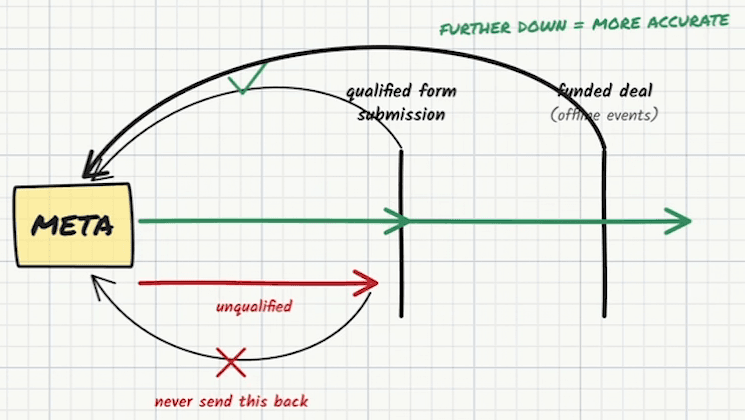
Firing the pixel on qualified submissions only is the rule that makes Meta ads work for funding at all. It is also only the first step. Once there is enough volume, what counts as qualified for the pixel can be stricter than what counts as qualified for the form, and the campaign gets better at finding the top of the market rather than the floor of it.
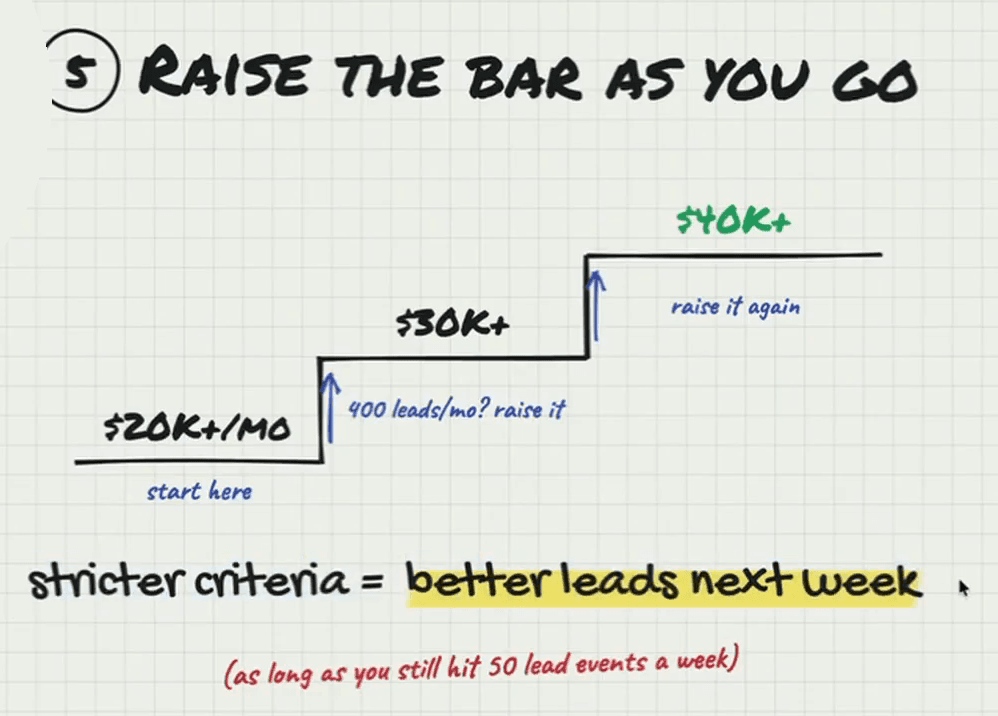
The later video puts numbers on where the bar starts and when it moves. Every new pixel Alex sets up, on a new ad account or for a new client, starts at merchants doing $20,000 a month, because a low bar gets the event count up quickly. As soon as the account has more than double the fifty a week Meta needs — 400 leads a month — the bar goes up, and then up again. Revenue is only one of the levers: whether the merchant has defaulted before, the state, the industry and the credit score can all be tightened the same way. The stricter the criteria, the better next week’s leads, as long as the account still clears fifty a week.
The three steps
| Step | The event Meta gets | Needs | For |
|---|---|---|---|
| 1 | A qualified form submission at a low bar: $20K a month on a new pixel | About 50 a week | Every account starts here |
| 1.5 | A qualified submission above a higher bar, raised in steps: $30K, $40K, then $50K or $100K | About 50 a week that clear the higher bar | Accounts producing more than 100 qualified leads a week (400 a month) |
| 2 | A lender submission or a funded deal, sent from the CRM as an offline event | About 50 a week; for funded deals, roughly 200 a month | Accounts spending $1,000 a day and more |
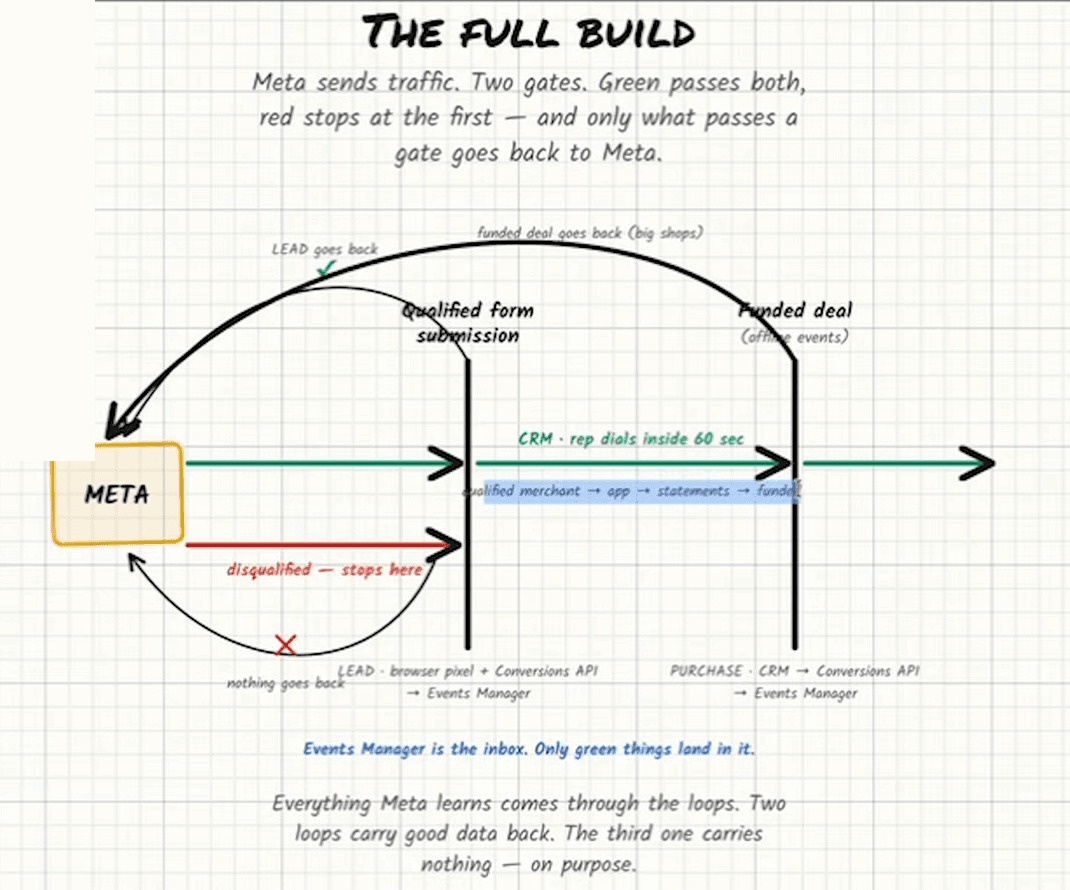
Step one is the event most accounts should be on. A merchant clicks the ad, goes through the funnel and submits an application that clears every gate, and at that point they are a lead: the pixel fires, and Meta reads it as “get me more of these”. That is good, and it produces good results on its own.
Step 1.5: a stricter bar for the pixel than for the form
Say the form qualifies merchants at $30K a month and a minimum credit score. Those merchants are all leads, and none of that changes. What changes is the event: the pixel fires only for the submissions doing $50K or $100K a month, so the only merchants Meta is told to find more of are the best ones the funnel is already producing. The form’s floor is for the floor; the pixel’s bar is for the algorithm.
The reason not to do it on day one is the fifty-a-week rule. Meta needs about fifty conversion events every week to have enough data to optimise on. An account producing fifty qualified leads a week at a $30K threshold should not raise the bar to $50K, because the event count would fall below what Meta can learn from. An account producing 100 a week has room for a step, and one producing 1,000 has room for several: enough of its merchants clear the higher bar to keep the count above fifty.
Step two: offline events from the CRM
The last step moves the event further down the sales process: true lender submissions logged in the CRM, or funded deals, sent back to Meta as offline events. The further down the process the data comes from, the more accurate the campaign gets and the better the pixel becomes over time, which is why funded deals beat form submissions. They need the same fifty a week, though, and for funded deals that is roughly 200 a month from Facebook alone, so offline events are for the largest accounts. A funded deal goes back as a Purchase with the deal amount as its value, matched to the original click by hashed email and phone.
Form submissions are not the weak option. Under $1,000 a day they are the only event to run, and step one or step 1.5 is the whole optimisation. Below $100 a day, none of them work, because no event clears fifty a week. What never changes, at any step, is the disqualified path: an unqualified submission goes to a separate page with no event and is never sent back to Meta. You paid for it, and it can still be worked, or sold on where the form’s consent language covers that, but whatever you give Meta is what you get back.