
On this page
The question of how little you can spend on Meta and still get somewhere has an arithmetic answer rather than an opinion, and it comes from the one number the delivery system runs on.
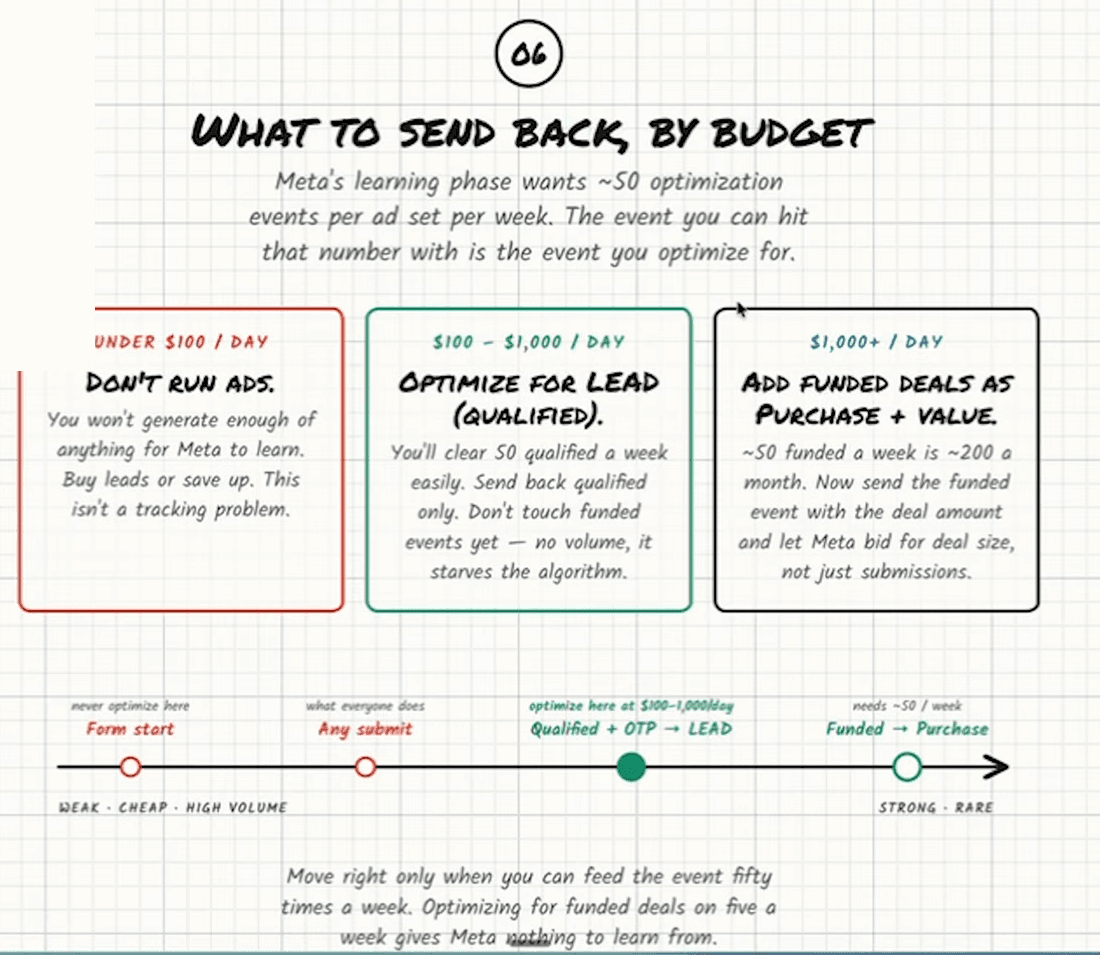
The three bands
| Daily spend | What to do | Why |
|---|---|---|
| Under $100 | Do not run ads | Under 29 qualified leads a week at $24.07 each, and fewer on a new account: nowhere near fifty, so the ad set never leaves learning |
| $100 to $1,000 | Optimise for the qualified lead event | At $24.07 a lead: about 29 qualified a week at $100 a day, fifty from about $172 a day, about 290 at $1,000; funded events are out of reach |
| $1,000 and up | Add funded deals as a Purchase event with the deal amount as the value | About fifty funded a week is roughly two hundred a month — only reachable here |
The floor is not about affording a decent test or having enough data to make decisions, though both are true. It is that Meta’s delivery system needs roughly fifty conversion events a week, per ad set, before it can optimise at all. Below that it stays in the learning phase, delivery is erratic, and the money is spent finding out almost nothing.
The arithmetic is the weekly budget divided by a qualified cost per lead of $15 to $30, and fifty a week needs a daily budget of cost per lead × 50 ÷ 7. At $100 a day, $700 a week buys between 23 and 47 qualified leads across that range (700 ÷ 30 to 700 ÷ 15), and about 29 at the $24.07 our main campaign measured. So $100 a day is where the qualified event gets enough volume to be worth running, not where it clears fifty; expect a longer learning phase at the bottom of the band than at $200. A new account also pays more than $24.07 for its first weeks, which pushes the number down further.
| Qualified cost per lead | Leads a week at $100 a day | Daily budget for fifty a week |
|---|---|---|
| $15 | About 47 | About $107 |
| $24.07, measured on our main campaign | About 29 | About $172 |
| $30 | About 23 | About $214 |
The rule underneath all three bands
The event you can feed fifty times a week is the event you optimise for. That single sentence decides the whole ladder. It is why a shop at $200 a day optimises for qualified submissions and not for funded deals, and it is also why a shop at $3,000 a day should not stay on qualified submissions forever: at that volume there are better events available, and raising the bar or moving to funded deals both become possible.
It also cuts the other way. Moving right on that spectrum for its own sake is the most common self-inflicted wound in a funding account: a shop funding five deals a week points the campaign at funded deals because it is obviously the better signal, and the ad set never leaves learning. The better signal you cannot feed is worse than the weaker signal you can.
Fifty a week per ad set, not per account
The threshold is per ad set, which is the detail that catches people who have read the number before. Splitting $150 a day across five ad sets to test five angles gives each of them $30 a day and none of them enough events, and the account performs worse than the same money in one. The same applies to pixels: each one needs its own fifty.
So at the bottom of the range, consolidate. One campaign, one ad set, one pixel, one event, and put the variation in the creative — ten to fifteen of them at $100 a day, and no more than fifteen, because creatives divide the budget too. Splitting is what you do when there is enough volume for both halves to clear fifty, which is a problem worth having and not one to manufacture early.
Questions brokers ask
What is the minimum daily budget for Meta ads for MCA leads?
$100 a day, and it is a floor rather than the point where fifty arrives. At our measured $24.07 per qualified lead, $100 a day is about 29 qualified leads a week (700 ÷ 24.07), and the roughly fifty a week Meta needs to optimise takes about $172 a day. Below $100 the ad set is nowhere near that, stays in the learning phase, and the spend teaches it nothing.
Why does Meta need fifty conversion events a week?
That is roughly the volume its delivery system needs to leave the learning phase and optimise reliably. Below it, single conversions swing the optimisation and delivery stays erratic.
Is the fifty-a-week rule per campaign or per ad set?
Per ad set. Splitting a small budget across several ad sets divides the events between them and can leave every one of them under the threshold, which is why small accounts should consolidate rather than test structurally.
What should I optimise for at $500 a day?
The qualified lead event — a submission that has cleared your gates and a one-time passcode. At that spend you will clear fifty a week comfortably, and funded deals are still far out of reach.
Should I run Meta ads with a $50-a-day budget?
No. At that level you are paying for a campaign that never finishes learning. Buy leads instead until the budget can support $100 a day, which is the point where the channel starts behaving.

Alex Makowski
Founder, Infinite Bookings
Runs the lead generation operation behind Infinite Bookings — paid traffic, the funding application, and the delivery pipeline that puts records into brokers’ CRMs.
Reachable directly at alex@infinitebookings.com or 732-609-7182.