
On this page
- How fast does it actually have to be?
- What do the shops with positive ROI do differently?
- How do I check my own dial time?
- What is actually happening in that first hour?
- How do I actually get to sixty seconds?
- What if my team genuinely cannot call that fast?
- Does texting count as speed to lead?
- Questions brokers ask
A shop came to us certain a batch was dead. Nobody picking up, whole order garbage, they wanted a refund — and their reps, they said, called every lead right away. Fair enough, so we asked them to export their CRM data and ran a report on it.
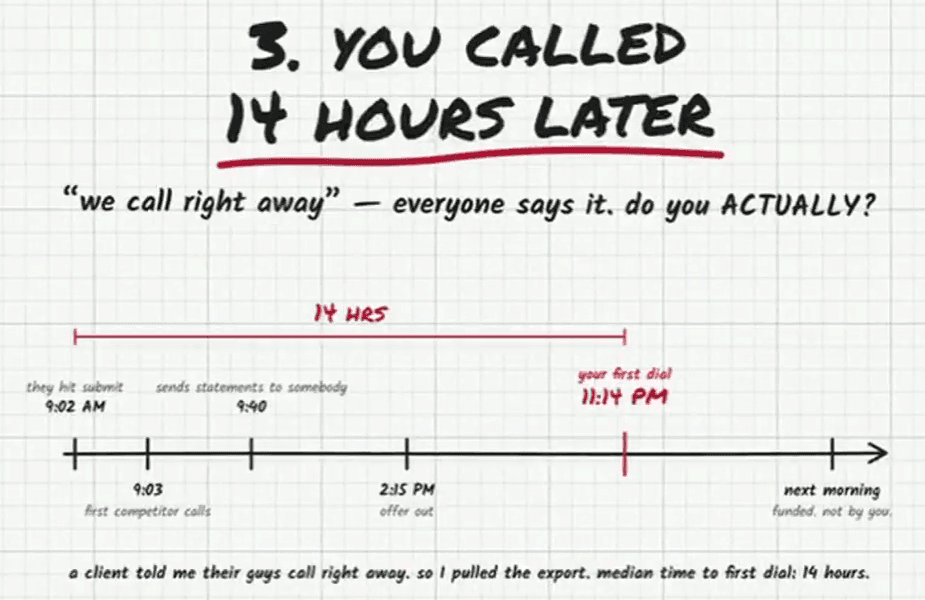
That is not a lead quality problem. That is a sales process problem wearing a lead quality costume, and it is by far the most common reason an order funds nothing. It is also the most common thing a floor gets wrong about itself: ninety percent of the brokerages Alex speaks to say they call right away, and the export almost never agrees. It is one of four reasons leads do not pick up, and the one to check first.
How fast does it actually have to be?
Share of merchants reached, by how long you waited
The shape is what matters here, not the exact percentages — reachability falls off a cliff in the first half hour and keeps falling. Waiting until tomorrow is not a slower version of calling now. It is a different outcome.
Illustrative curve. The drop at thirty minutes follows the figure on Alex’s board in the pickup-rate video — pickup about 60% lower — and the later points only show that it keeps falling.
Alex’s standard is a rep on the phone inside sixty seconds. In the essentials video he puts five minutes on the wrong side of the line: calling in five minutes, an hour or the next day is burning the ad spend that produced the lead. What else is a rep doing that matters more? Calling new leads is the job.
What do the shops with positive ROI do differently?
Honestly? Four things. That is the whole list, and none of it is clever:
- Call within five minutes of the lead landing — not five hours.
- Text and email immediately, not just call.
- Double dial. One unanswered ring is not a contact attempt.
- Follow up more than once before writing the merchant off.
It is not proprietary and there is no secret in it. It is either done, or it is not.
How do I check my own dial time?
You already have the data. This takes about twenty minutes and it is the highest-value thing you can do before spending another dollar on leads.
- Export the last 90 days of leads with their created timestamp and their first outbound call timestamp.
- Compute the median, not the mean. One weekend batch will drag an average and hide the real picture entirely.
- Split it by hour of day. Most floors have a specific window where leads sit — usually early morning and after close.
- If the median is over a minute, fix that before buying more leads. More volume into the same delay produces the same result at higher cost.
- Then keep going past the first dial: time to get the offer out, time to get the application link in. Export it once a month and actually read it — it is the only version of your speed to lead that is not an opinion.
What is actually happening in that first hour?
It helps to picture it from the merchant’s side rather than yours. They filled in a funding application because something is due — payroll, a repair, an inventory buy with a deadline. They are not browsing.
| Time since submit | What the merchant is doing | What your call sounds like |
|---|---|---|
| 0–5 min | Still at the screen, still thinking about it | Expected. They remember applying. |
| 5–60 min | Back to work, phone nearby | Welcome, mildly surprising |
| 1–4 hr | Has taken one or two other calls | You are comparing yourself to someone |
| 4–24 hr | Has offers to weigh, or has moved on | You are late and it shows |
| 24 hr+ | Funded elsewhere, or has stopped answering | Most of these never connect |
Nothing about the lead changed across those rows. What changed is how many other conversations the merchant has had, and there is no pitch that undoes that.
How do I actually get to sixty seconds?
Almost nobody fails this because they do not care. They fail because the lead lands somewhere nobody is watching. Four fixes cover most of it:
- Route to a person, not a queue. A lead assigned to "the team" is assigned to nobody. Round-robin to a named rep, and reassign automatically if there is no call or text within five minutes.
- Make the alert impossible to miss. An email notification is not an alert. Push, SMS to the rep, or a visible board — something that interrupts.
- Cover the edges of the day. Most floors have a gap at open and after close, and merchants apply in both. Staff those windows, cap delivery to hours you actually cover, or have a text and an email fire automatically and book the call for first thing in the morning.
- Measure it weekly. Median time to first dial, per rep, on a board everyone sees. What gets measured gets dialled.
Underneath all four is the delivery. A lead that lands in a Google Sheet waits for somebody to open the sheet — nobody owns the row, nothing alerts, and there is no first-dial timestamp to measure. Alex’s board puts it flatly: a sheet is where the fourteen hours comes from. Take delivery by webhook straight into the CRM and let the CRM do the alerting.
What if my team genuinely cannot call that fast?
Then buy differently, rather than buying the same thing and hoping. Being honest about your own operation is worth more than any vendor selection:
- Throttle delivery. Fewer leads per day, each worked properly, beats a volume you cannot cover.
- Narrow the delivery window to the hours you are actually staffed.
- Consider live transfers instead. They cost more per unit and solve exactly this problem, because the merchant is already on the phone.
- Fix the routing before you increase spend. More leads into the same delay produces the same result at higher cost.
Does texting count as speed to lead?
It counts, and it helps, but it does not replace the call. A text within a minute buys you permission to ring — it makes your number familiar rather than unknown, which measurably lifts pickup on the dial that follows. It is an accelerant, not a substitute. Text first, then call has what to send.
The shops that do best send both: a text immediately, a call within five minutes, then an email with something concrete in it. Three channels inside the first ten minutes, then a real follow-up cadence rather than one attempt and a write-off.
Questions brokers ask
How fast should you call an MCA lead?
Inside sixty seconds of the lead landing; five minutes is already late. Pickup falls by about sixty percent once thirty minutes have passed and keeps falling — a merchant who submitted at 9am has usually taken one or two other broker calls by lunchtime. The shops reporting the best outcomes call inside five minutes and text at the same time.
Why are my MCA leads not answering the phone?
The most common cause is dial time, not lead quality. Export your last ninety days of leads with their created and first-call timestamps and compute the median. If it is above five minutes, that is the problem before anything about the leads is. A shop convinced a batch was dead turned out to have a fourteen-hour median first dial.
How do I measure time to first dial?
Export leads with their created timestamp and first outbound call timestamp, then compute the median rather than the mean — one weekend batch will drag an average and hide the picture. Split it by hour of day; most floors have a gap at open and after close where leads sit.
Does texting a lead work better than calling?
Neither replaces the other. A text within a minute makes your number familiar rather than unknown, which lifts pickup on the call that follows. The best-performing shops send a text immediately, call within five minutes, and follow with an email — three channels inside the first ten minutes.
What if my sales team cannot call leads within five minutes?
Buy differently rather than buying the same leads and hoping. Throttle delivery to fewer leads per day, narrow the delivery window to hours you are actually staffed, or consider live transfers, which cost more but put the merchant on the phone already. Fix routing before increasing spend.

Alex Makowski
Founder, Infinite Bookings
Runs the lead generation operation behind Infinite Bookings — paid traffic, the funding application, and the delivery pipeline that puts records into brokers’ CRMs.
Reachable directly at alex@infinitebookings.com or 732-609-7182.