
The question Alex gets asked most is what the cost per lead is. Cost per lead is the least useful number in the business. He tracks the full funnel from first dial to funded deal and how much each deal funded for, and he reduces it to two numbers that brokers rarely ask about.
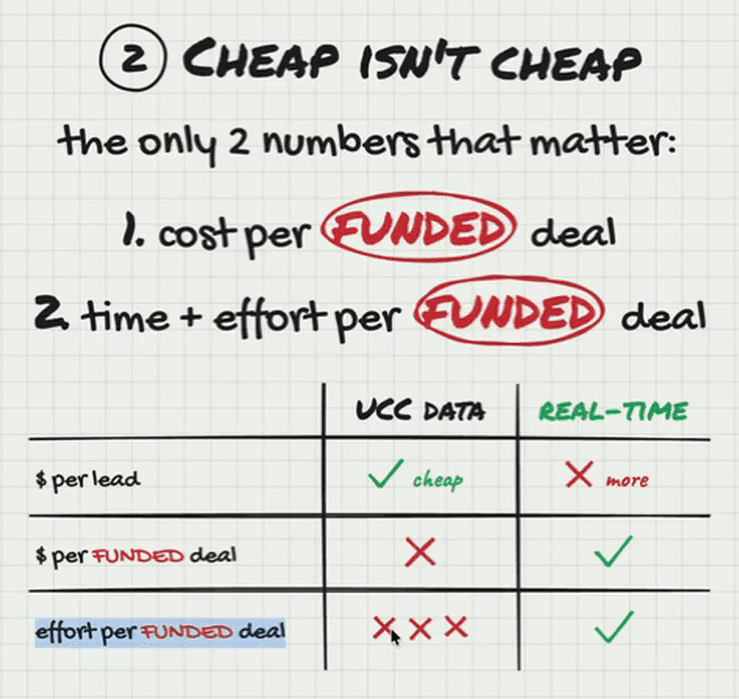
The two numbers
- Cost per funded deal: total marketing spend in a month divided by the deals funded. Fund ten deals and you can see what each one cost, and which source most of them came from, so next month’s budget follows it.
- Time and effort per funded deal: the dials, texts, emails, voicemails and follow-ups behind each funded deal, in rep hours. Nobody invoices you for it, so it goes unmeasured.
The second number is the one that catches out cheap data. In Alex’s words, he could bring a shop’s cost per lead and cost per funded deal down to zero, and the shop would be dialling sixteen hours a day calling dead leads. Hours are a cost even when payroll treats them as fixed. A rep spending a day on a list where about 1% connects is not working the lead who asked to be called.
How the two numbers compare by source
| UCC data | Real-time leads | |
|---|---|---|
| Cost per lead | Cents | $30 to $100 |
| Leads per funded deal | A very large list | Roughly 20 to 30 per one or two deals |
| Cost per funded deal | Often high, at best comparable | Usually equal or lower |
| Effort per funded deal | Immense, even at 12 hours a day | Far lower: they are expecting the call |
To measure it, tag every lead with its source, log rep hours by source for a month, and divide by deals funded from each. It does not need to be precise to be decisive. If real-time leads produce one deal per 25 leads and the list produces one per several thousand records, the hours per deal will differ by an order of magnitude whatever the payroll assumption. The cost per funded deal calculator handles the money half, and the comparison of UCC and real-time leads covers what to do with the answer.
Questions brokers ask
What numbers matter most when buying MCA leads?
Cost per funded deal and time and effort per funded deal. Cost per lead is what everybody asks about, and it says the least about whether a lead source pays.
How do I calculate time and effort per funded deal?
Tag every lead with its source, log rep hours spent on each source for a month, and divide by the deals funded from each. It does not need to be precise to show which source eats the floor’s day.
Why is cheap lead data not actually cheap?
Because the cost moves from the invoice to the floor. A list that costs cents a record needs thousands of dials, texts and follow-ups per funded deal, and those hours are what you are paying for.
How many real-time leads does it take to fund a deal?
Roughly 20 to 30 leads per one or two funded deals, depending on how fast and how well the floor calls and closes. Our clients report two to four funded per fifty exclusive leads.
Can a lead source have a low cost per funded deal and still be a bad one?
Yes. A list can bring cost per funded deal close to zero and still have reps dialling sixteen hours a day to reach anyone. If the effort per deal is enormous, the source is costing you in hours what it saves on the invoice.
Reference
Watch: why you should stop buying UCC dataThe two numbers, at 2:31, and the worked example at 11:16.

Alex Makowski
Founder, Infinite Bookings
Runs the lead generation operation behind Infinite Bookings — paid traffic, the funding application, and the delivery pipeline that puts records into brokers’ CRMs.
Reachable directly at alex@infinitebookings.com or 732-609-7182.