
The price of a UCC list is the number brokers compare, and it is the smallest cost in the chain. Everything after the purchase is labour, system clutter and lost deals, and none of it appears on the list vendor’s invoice.
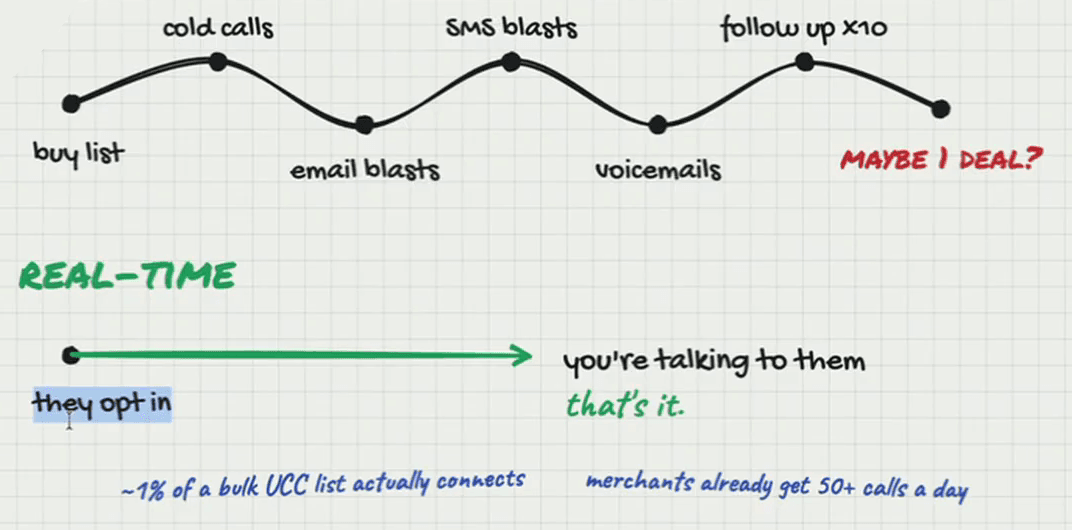
The chain behind one UCC deal
- Buy the list. Cents a record, and the cheapest part of the whole thing.
- Cold call it. About 1% of a bulk list actually connects.
- Email blast it and SMS blast it, with the deliverability and consent questions that come with both.
- Leave voicemails.
- Load it into the CRM, where it clutters the system with records nobody asked to be in.
- Follow up, up to ten times, while the merchant is being shopped by every broker who bought the same filings.
- Maybe fund one deal.
Alex’s point is that the merchants on a UCC list are being shopped around. The same filings are sold to everyone, merchants who took an advance once already get fifty or more calls a day, and the risk of the one who does pick up going with another broker is much higher than on a lead who asked for you. Even after all that, you still do not know what you have, because the record does not tell you the revenue, the ask or whether they need money now.
The real-time line
The lower line on the board has two points. The merchant opts in, and the second they verify their phone with a six-digit passcode the lead is sent to you. You call within sixty seconds. They pick up and tell you they just applied for capital, they are looking for $50,000, they do $100K a month, they have no defaults and a 720 score. Pickup on our real-time leads runs at 40 to 50% across clients, against about 1% on a bulk list, because the call lands within a minute of them asking for it.
That is why cost per record is the wrong comparison. The chain above is a time and effort per funded deal problem, and no list discount fixes it. For how a UCC list is built and what it contains, the three-way comparison of UCC, aged and live-transfer leads covers it.
Questions brokers ask
What percentage of a UCC list actually connects?
About 1% of a bulk UCC list, on Alex’s board. The filings are public and sold to everyone, so the merchants who took an advance before are already getting 50 or more calls a day.
What is the real cost of working UCC leads?
Everything after the purchase: cold calls, email and SMS blasts, voicemails, CRM clutter and up to ten follow-ups per merchant, often for one deal at the end. The list itself is the cheapest part.
What pickup rate do real-time MCA leads get?
Across our clients, 40 to 50%, because the call lands within a minute of the merchant opting in and verifying their phone. A bulk UCC list connects at around 1%.
Why do UCC leads not pick up the phone?
Because nobody on the list asked to be called, and the same filings are sold to every broker. A merchant who took an advance once can get 50 or more broker calls a day and stops answering unknown numbers.
Is selling real-time leads different from cold calling UCC data?
Yes. The merchant just applied and is expecting the call, so the job is answering their questions rather than interrupting their day. Brokers used to UCC data often have to adjust to how easy the conversation is.
Reference
Watch: why you should stop buying UCC dataThe UCC chain at 5:10, and the 1% against 40 to 50% at 6:29.

Alex Makowski
Founder, Infinite Bookings
Runs the lead generation operation behind Infinite Bookings — paid traffic, the funding application, and the delivery pipeline that puts records into brokers’ CRMs.
Reachable directly at alex@infinitebookings.com or 732-609-7182.