
On this page
Most MCA shops that run a floor of ten or twenty reps run it on UCC data, because it is the cheapest thing a rep can dial all day. Alex sells leads for a living and calls himself a numbers guy: if a thing makes money, it makes sense. His argument is still that UCC data should be phased out. It does make money, but cost per record is the wrong number to judge it on.
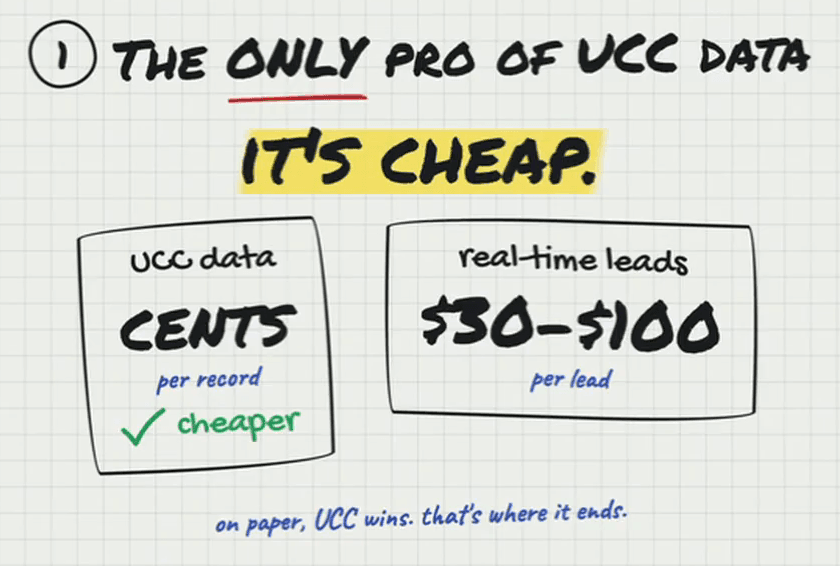
The one thing UCC data has going for it
It is cheap. A UCC list costs cents a record and you can buy hundreds of thousands of them. Real-time leads are quoted at $30, $50, $120, even $200 a lead depending on the vendor; ours are $60 per lead for exclusive. Compared on the invoice, nobody would choose the expensive one. That comparison is where the case for UCC starts, and also where it ends.
UCC data against real-time leads, side by side
| UCC data | Real-time leads | |
|---|---|---|
| Price | Cents a record | $30 to $100 a lead, more from some vendors |
| Cost per funded deal | Usually high: a lot of records per deal | Usually equal or lower |
| Time and effort per funded deal | Very high: dials, blasts, voicemails, follow-up | Low: they asked to be called |
| Who you reach | Whoever is on the list | The industry, revenue, credit and defaults you set |
| Response | Around 1% of a bulk list connects | 40 to 50% pickup across our clients |
| Who else is calling | Every broker who bought the same filings | Nobody, if exclusive and called in 60 seconds |
The second and third rows are the ones that matter. Cost per funded deal is how much marketing spend it takes to fund one deal. Time and effort per funded deal is how many hours of dialling sit behind it. A UCC list can get the first close to zero and still lose on the second, because the floor spends sixteen hours a day calling people who did not ask. Everything that happens after you buy the list is where the real cost is.
Phase it out, do not switch it off
Alex does not argue for cancelling the UCC list on Monday. If a dollar in returns a dollar fifty, that is profit, and a profit you already have should keep running while you test something else. The argument is about where the next dollar goes. A list that returns 1.5 times what it costs is worth keeping until a channel returning five to ten times can carry the floor. Then the list becomes the thing that keeps reps busy between real leads, and later it is not needed at all.
- Keep the UCC list running, and stop expanding it.
- Put a fixed slice of the budget into real-time leads, bought or from your own ads, and track them separately.
- Call every real-time lead inside sixty seconds. It is the one condition the rest depends on.
- After a month, compare cost per funded deal and hours per funded deal for each source, not cost per lead.
- Move budget towards whichever wins on those two numbers.
His warning is about timing. Shops dialling the same old lists in New Jersey, Staten Island and Brooklyn still fund deals, and they will keep funding some. The competition is now marketing companies that understand the ad side, and trying real-time leads now costs a fraction of what being forced into it in two or three years will cost. The $1,000 worked example shows the arithmetic, and what Meta knows that a list does not explains why it works.
Questions brokers ask
Is UCC data worth buying for MCA?
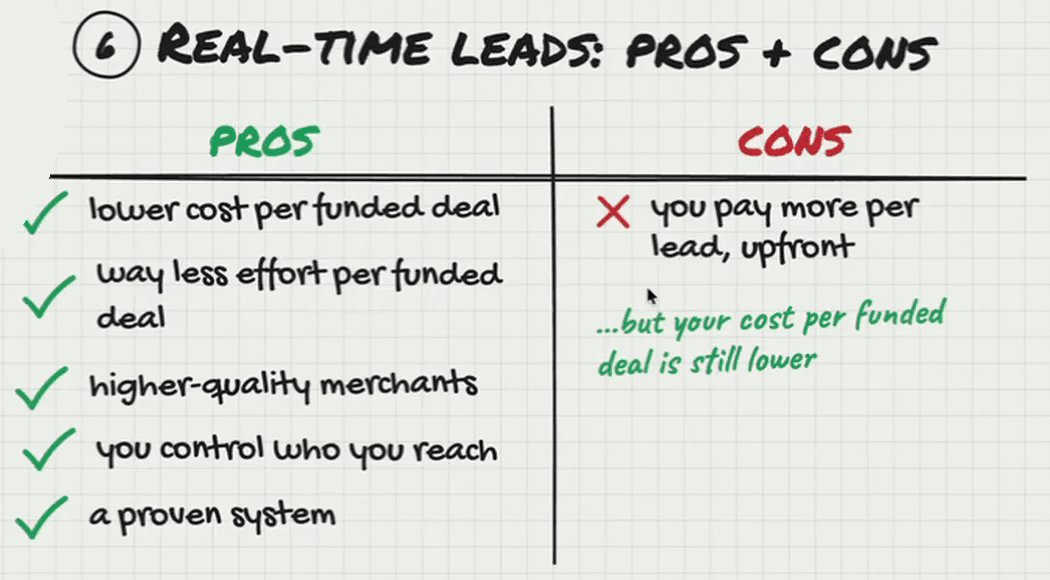
It makes some money, but it wins only on price per record. On cost per funded deal and on time and effort per funded deal, real-time leads usually come out equal or better, which is why Alex argues for phasing UCC data out rather than expanding it.
How much does UCC data cost compared with real-time leads?
UCC data costs cents a record. Real-time MCA leads cost roughly $30 to $100 a lead, with some vendors charging $120 to $200; our exclusive leads are $60. The price per record is the only comparison UCC data wins.
Should I stop buying UCC lists straight away?
No. If the list returns more than it costs, keep it running while you test real-time leads on a fixed budget. Compare cost per funded deal and hours per funded deal after a month and move money to whichever wins.
What is the downside of real-time MCA leads?
You pay more per lead, upfront, and you have to call each one within sixty seconds. The cost per funded deal is usually still equal or lower, and the effort behind each deal is far lower.
What do I do with a floor of 20 reps if I stop buying UCC data?
Phase the list down rather than off. Reps keep working the list between real-time leads, and the share of their day spent on leads who asked to be called grows as those leads prove themselves on cost per funded deal.
Reference
Watch: why you should stop buying UCC dataThe full argument, board by board, with the $1,000 worked example.

Alex Makowski
Founder, Infinite Bookings
Runs the lead generation operation behind Infinite Bookings — paid traffic, the funding application, and the delivery pipeline that puts records into brokers’ CRMs.
Reachable directly at alex@infinitebookings.com or 732-609-7182.